
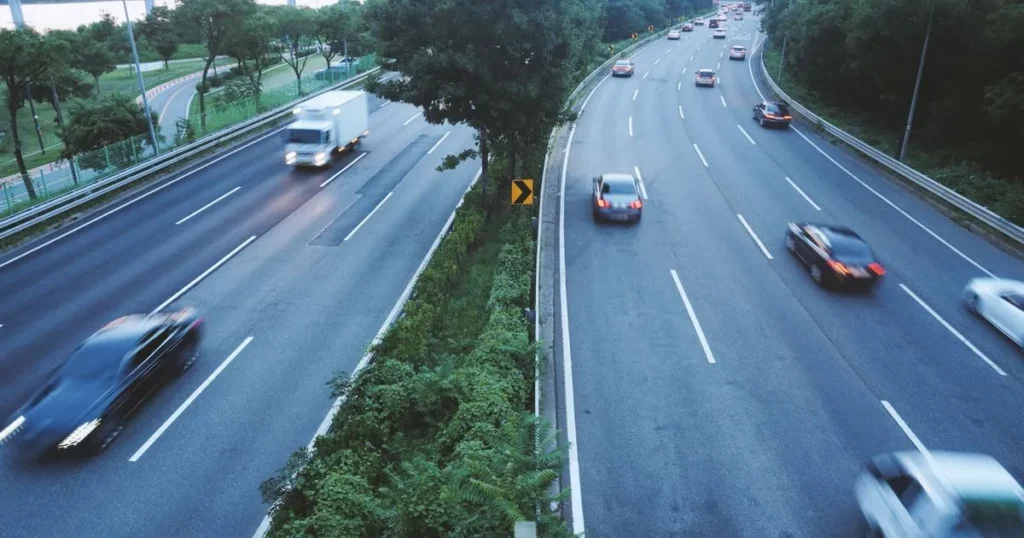
A lane change accident fault in Salt Lake City dispute almost always starts with the same two sentences: “They came into my lane.” — “No, they came into mine.” On the fourteen-lane stretches of I-15 through the city, the I-80 weaves at the Spaghetti Bowl, and the I-215 collector lanes, sideswipe and merge collisions are the everyday crash — and because they happen between mirrors at 65 mph, they’re the crash insurers most love to call “unresolvable.” Utah law disagrees, and so does the evidence. Here’s how lane-change fault actually gets decided.
Quick Answer: Who is at fault in a lane-change or merge accident in Salt Lake City? Utah law places the duty on the driver changing lanes or merging: a lane change may only be made when it can be completed safely, which means the driver leaving their lane must yield to traffic already occupying the destination lane. In practice, the merging or lane-changing driver is at fault in most sideswipe collisions — and the dispute is usually which driver was the one moving, a question answered by damage geometry, vehicle event data, dash cams, and UDOT freeway cameras rather than by either driver’s story.
The Rule: The Moving Driver Yields
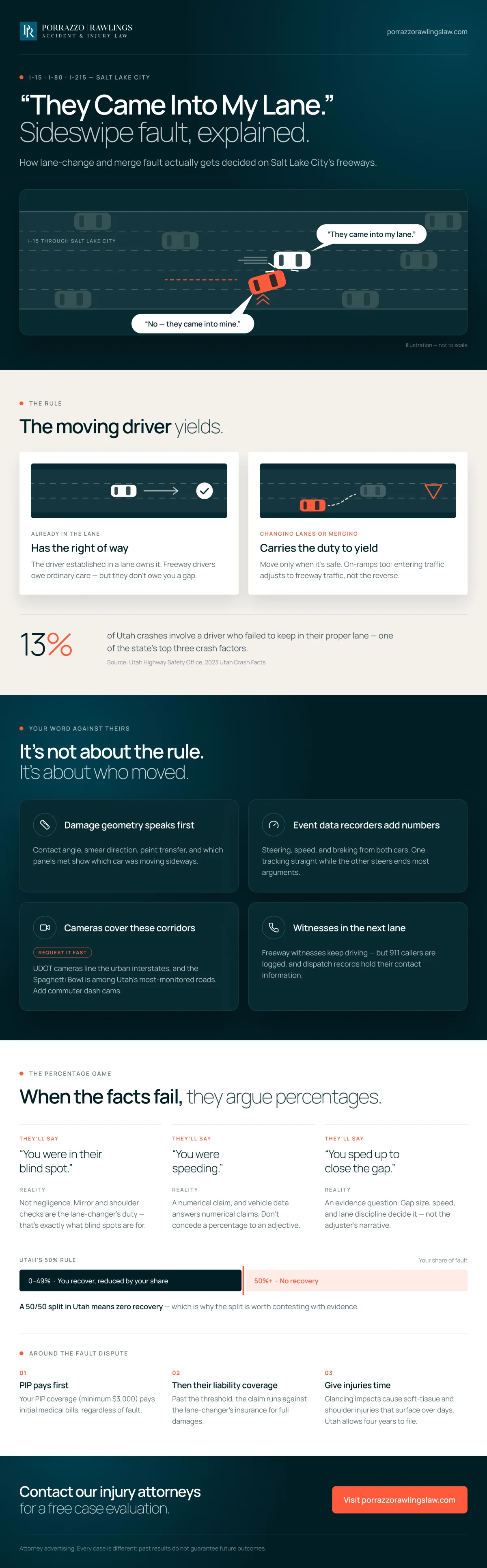
Utah’s traffic code is unambiguous about the duty. A vehicle must stay within a single lane and may move from it only when the driver has first determined the movement can be made safely — the lane-change codification of the state’s broader care requirements. The driver already established in a lane has the right of way in it; the driver entering it assumes the duty. The same logic governs ramp merges: entering traffic adjusts to freeway traffic, not the reverse (freeway drivers owe ordinary care, but they don’t owe you a gap).
Which means most lane-change disputes aren’t really about the rule — both insurers know it. They’re about the facts: which vehicle crossed the line. That’s an evidence question, and Salt Lake City’s freeways are surprisingly good at answering it.
How “Your Word Against Theirs” Gets Resolved
Damage geometry speaks first. Sideswipe damage patterns encode direction: the angle and smear of contact, which panels struck which, paint transfer direction, and wheel-well versus door contact routinely establish which vehicle was translating laterally. Accident reconstructionists read sideswipes the way arborists read tree rings — and adjusters know a documented geometry argument beats a recorded statement.
Event data recorders add the numbers. Steering input, speed, and braking in the seconds before impact live in both vehicles’ modules. A car tracking straight while the other shows steering deflection ends most arguments.
Cameras cover these corridors. UDOT’s traffic operations cameras run the length of the urban interstates, and the Spaghetti Bowl interchange is among the most-monitored road real estate in Utah. Add commuter dash cams — increasingly the decisive witness — and the footage question isn’t usually whether the crash was seen, but whether anyone requested the recording before it cycled out. Retention runs short; requests can’t wait.
Witnesses in the next lane over. Freeway witnesses keep driving unless someone stops them — but 911 callers are logged, and their contact information is recoverable from the dispatch record.
Statewide data underlines why these crashes cluster here: the Utah Highway Safety Office puts improper lane travel among Utah’s leading contributing factors — roughly one in eight crashes — and the heaviest concentrations sit exactly where lane counts and traffic volumes peak: Salt Lake City’s interstate core.
The Percentage Game
Because pure “who crossed the line” losses are hard to defend, lane-change insurers pivot to Utah’s comparative negligence rule: you were speeding, you were in their blind spot, you accelerated into the gap. Every percentage point that sticks reduces your recovery by the same amount, with recovery barred at 50%. Two things about that. First, “being in a blind spot” is not negligence — mirror and shoulder checks are the changing driver’s duty, and a blind spot is exactly what they exist for. Second, speed arguments are numerical claims, and vehicle data answers numerical claims; don’t concede a percentage to an adjective.
Assembling that record while injured is the practical work of Salt Lake City auto accident lawyers: camera and 911-record requests filed within days, both vehicles’ data preserved before repair or salvage, the geometry documented photographically, and the insurer’s percentage arguments met with numbers instead of narratives.
The Claim Around the Fault Dispute
The rest runs on Utah’s standard rails — covered step-by-step in our Salt Lake City crash guide: PIP pays initial medical bills (minimum $3,000) regardless of fault; past the threshold, the claim proceeds against the lane-changer’s liability coverage for full damages. Sideswipe injuries deserve particular patience — the rotational forces of a glancing freeway impact produce exactly the soft-tissue and shoulder injuries that surface over days — and the four-year statute of limitations under Utah Code § 78B-2-307 leaves room to get the medical picture complete before anyone talks numbers. If your crash was the multi-vehicle chain-reaction kind rather than a two-car sideswipe, our Point of the Mountain pileup guide covers how percentage fault works when four insurers point at each other. And if it started with a signal instead of a lane line, the red-light runner playbook is its own genre.
The firm behind all of it works one way: more than 100 years of combined experience, a deliberately limited caseload, the same attorney from day one until your check is in hand, no paralegal triage. Bill Rawlings is a former insurance adjuster, which matters most in exactly these claims: we know what a carrier’s “unresolvable sideswipe” file looks like from the inside, and what evidence reclassifies it. The statewide framework lives in our overview of how car accident claims work across Utah.
Frequently Asked Questions
We both say the other drifted. Doesn’t that just end in 50/50? Rarely, if the evidence is developed. Damage geometry, steering data, and footage usually identify the moving vehicle — and a documented answer beats a split. Accepting 50/50 in Utah is accepting zero recovery, so the split is worth contesting.
I was merging from an on-ramp when we collided. Am I automatically at fault? Not automatically — but the merging driver carries the yield duty, so the presumption leans against you and the evidence has to do the work: gap size, the freeway driver’s speed and lane discipline, and whether they accelerated to close your gap all matter.
The other driver’s insurer says I was in their blind spot. Is that a defense? No. Checking blind spots is the lane-changing driver’s duty; your lawful presence in an adjacent lane is never negligence. Treat the argument as the percentage play it is.
Does a dash cam actually help in these claims? Enormously — your own or anyone’s. Sideswipe fault is a direction-of-movement question, and video answers it in one viewing. If you drive SLC’s freeways daily, a dash cam is the cheapest claim insurance sold.
Sideswiped on the Interstate? Get the Evidence Working — Free
Their insurer is already writing the “unresolvable” version. The cameras, the modules, and the metal say otherwise — for a limited time. Call (801) 553-0505 to speak directly with an attorney — consultations are free, we’re available 24/7, and our attorneys serving Salt Lake City will start the preservation work today. Zero-fee guarantee: you pay nothing unless we win or settle, with all case costs advanced.
Disclaimer: This article is for informational purposes only and does not constitute legal advice. Reading this article does not create an attorney-client relationship. Every case is different, and no guarantees or promises can be made regarding the outcome of any claim or the amount of any compensation. Past results do not guarantee future outcomes. If you have been injured, consult directly with a qualified Utah attorney about your specific situation.