

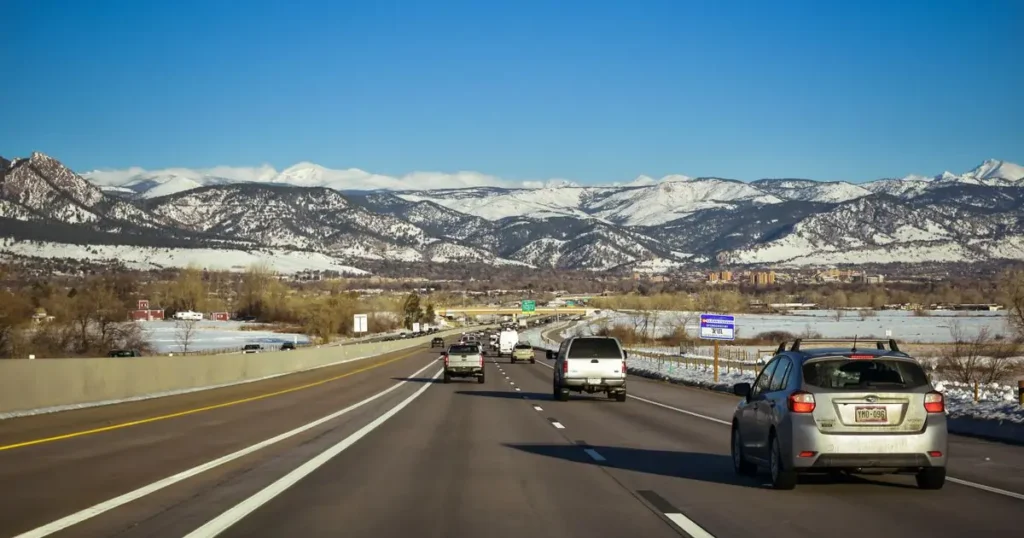
Every Wasatch Front commuter knows the Point of the Mountain. It’s where Salt Lake County meets Utah County, where six-plus lanes of I-15 crest the ridge between Draper and Lehi — and where weather, wind, grade, and some of the heaviest traffic volumes in the state collide. When something goes wrong here, it rarely involves just two cars. Chain-reaction collisions, sudden-stop rear-end crashes, and semi-truck incidents make an I-15 accident in Draper, Utah one of the most legally complicated crash types in the state.
Our Draper office sits minutes from this stretch of I-15, and we’ve represented clients injured in nearly every kind of crash it produces. This article explains what makes Point of the Mountain collisions different, how Utah decides who pays when multiple vehicles are involved, and what injured drivers should do to protect themselves.
Quick Answer: Who pays after a multi-car I-15 accident at the Point of the Mountain in Draper, Utah? In a multi-car pileup on I-15 near Draper, Utah’s modified comparative negligence rule assigns each driver a percentage of fault, and any driver found less than 50% at fault can recover damages from the other drivers’ insurers — reduced by their own share of fault. Fault percentages are established through crash reports, vehicle damage patterns, event data recorders, and witness statements, which is why evidence preservation matters more in pileups than in any other crash type.
Why the Point of the Mountain Produces So Many Serious Crashes
A few local realities stack the deck at this stretch of interstate:
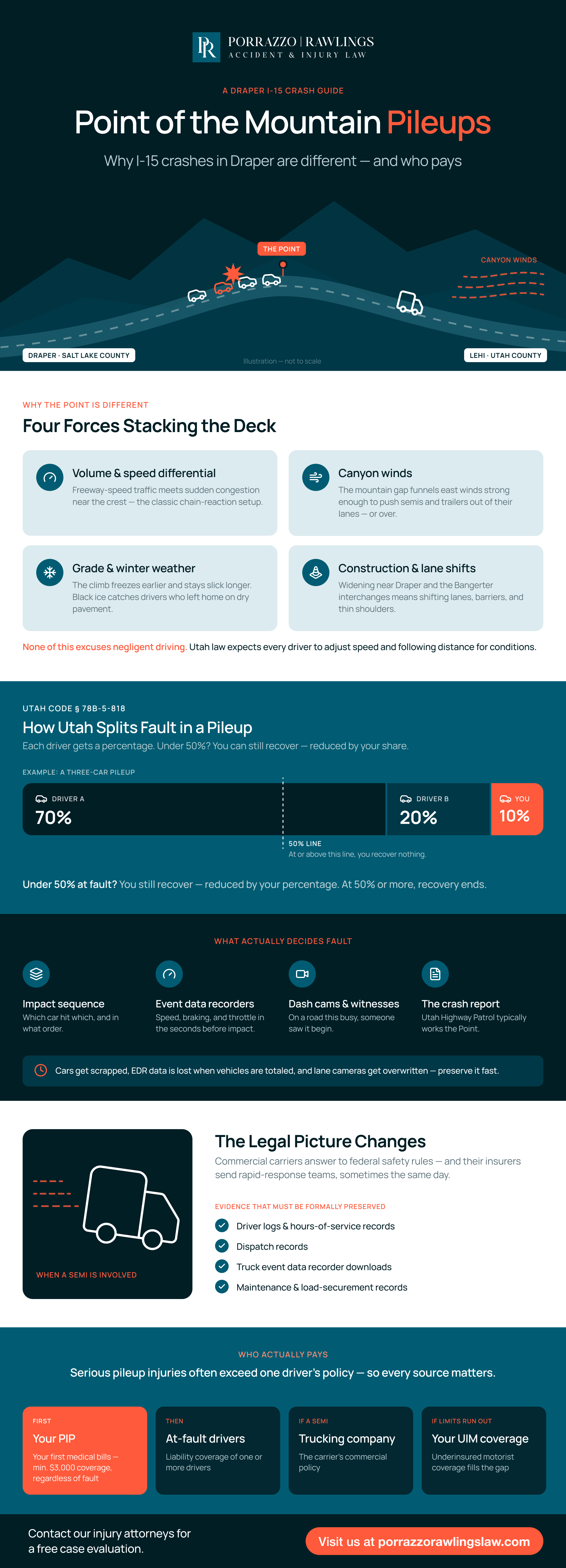
Traffic volume and speed differential. This corridor carries some of the highest traffic counts in Utah as commuters move between Salt Lake County and the fast-growing Silicon Slopes cities. Congestion forms suddenly near the crest, and vehicles traveling at freeway speed meet stopped traffic with little warning — the classic recipe for chain-reaction rear-end collisions.
Canyon winds. The gap in the mountains funnels powerful east winds across the freeway, strong enough to push high-profile vehicles — semi-trucks, trailers, box trucks — out of their lanes or over entirely. Wind-related rollovers here regularly close lanes in both directions.
Grade and winter weather. The climb and descent freeze earlier and stay slick longer than the valley floor. Black ice on the Draper side catches drivers who left home on dry pavement.
Constant construction and lane shifts. Ongoing widening and development around Draper and Bangerter Highway interchanges means shifting lanes, temporary barriers, and reduced shoulders — all of which compress reaction time.
None of this excuses negligent driving. Utah law expects every driver to adjust speed and following distance for conditions. A driver who plows into stopped traffic “because of the sun” or “because of the ice” is still, in most cases, a negligent driver.
How Utah Assigns Fault in Multi-Vehicle Pileups
Two-car crashes are usually straightforward. Pileups are not. When five vehicles collide in a chain, each insurance company points at someone else, and injured drivers get caught in the crossfire.
Utah resolves this through modified comparative negligence under Utah Code § 78B-5-818: each party is assigned a percentage of fault, and you can recover damages so long as your own fault is less than 50% — with your recovery reduced by your percentage. If you’re found 10% at fault in a pileup with $100,000 in damages, you can still recover $90,000 from the other at-fault parties.
In practice, a multi-car pileup fault determination in Utah comes down to evidence:
- Impact sequence and damage patterns. Which vehicle hit which, and in what order? Rear-damage-only vehicles tell a different story than vehicles hit front and rear.
- Event data recorders (EDRs). Most modern vehicles record speed, braking, and throttle in the seconds before impact — often the decisive evidence in disputed chains.
- Dash cameras and witness accounts. On a road this busy, someone usually saw the sequence begin.
- The crash report. The Utah Highway Patrol typically works interstate crashes at the Point; statewide crash records and safety data are maintained by the Utah Department of Public Safety’s Highway Safety Office, whose data consistently shows how heavily crashes concentrate along Utah’s urban I-15 corridor.
This is why the hours after a pileup matter. Vehicles get towed and scrapped, EDR data gets lost when cars are totaled out, and lane-camera footage gets overwritten. Preserving that evidence quickly is one of the most valuable things an attorney does in a multi-vehicle case.
When a Semi-Truck Is Involved
Wind and grade make this corridor especially dangerous for commercial vehicles, and semi-truck crashes at the Point change the legal picture entirely. Commercial carriers are subject to federal safety regulations — hours-of-service limits, maintenance requirements, load securement, and wind-restriction judgment calls — and their insurers deploy rapid-response teams to the scene, sometimes the same day. Evidence like driver logs, dispatch records, and truck EDR data must be formally preserved before it disappears. If your crash involved a commercial vehicle, our truck accident practice explains how these claims differ and why they’re valued differently than car-only collisions.
What to Do After an I-15 Crash Near Draper
- Get out of the travel lanes if you safely can. Secondary impacts in live freeway lanes cause some of the worst injuries in pileup events.
- Call 911 and report injuries honestly — including “I’m not sure yet.” Adrenaline masks a great deal.
- Photograph the full scene, not just your car: the positions of all vehicles, the roadway, weather conditions, and any trucks involved.
- Collect witness contacts. In multi-vehicle crashes, independent witnesses who saw the first impact are gold.
- Get medical care the same day and follow through with treatment.
- Hold off on recorded statements. In a pileup, three or four insurance companies may call you. You’re not required to give any of them a recorded statement, and in a disputed-fault chain collision, you shouldn’t — not before you understand where fault is being assigned. Our guide on what to do when police reports get the story wrong covers a related problem we see often in chain crashes.
Remember Utah’s baseline rules, too: your own PIP coverage pays your first $3,000 in medical bills regardless of fault, and the general deadline to file an injury claim is four years — though as we covered in our Sandy crash guide, the practical evidence deadlines arrive far sooner.
Who Actually Pays — and How Much?
Depending on the facts, compensation in a Point of the Mountain crash may come from several directions at once: the liability coverage of one or more at-fault drivers, a trucking company’s commercial policy, your own underinsured motorist coverage if the at-fault drivers’ limits are too low for serious injuries, and your PIP benefits for initial medical bills. Serious pileup injuries — spinal damage, traumatic brain injuries, fractures requiring surgery — routinely exceed a single driver’s policy limits, which makes identifying every available policy essential. No attorney can promise what any specific case is worth; anyone who does should raise a red flag. What a good attorney can do is make sure nothing gets left on the table.
Local Counsel for a Local Corridor
At Porrazzo Rawlings Accident & Injury Law, this stretch of freeway is our backyard — our Draper office is minutes from the Point, and as a Draper car accident lawyer team, we know its crash patterns, its responding agencies, and the insurers on the other side. Our promise is simple: big firm settlements with small firm personal attention. We’ve recovered hundreds of millions for injured Utahns, but we intentionally limit how many cases we take so that every client works directly with a real attorney from the first call to the final resolution. You will never be passed off to a paralegal or case manager, and you will never be just a case number — in a pileup case with four insurers pointing fingers, having one attorney who knows your file cold is not a luxury. It’s the difference.
Several of our attorneys spent years as insurance adjusters and defense counsel before joining our side. When an insurer tries to pin 30% of a chain-reaction crash on you to cut their payout, we’ve seen the playbook — because we used to hold it.
Injured at the Point? Get Answers Today — Free
If you or someone you love was hurt in an I-15 crash near Draper, the insurance companies are already working on their version of the story. Get yours on the record. Call (801) 553-0505 now to speak directly with an attorney — we’re available 24/7, consultations are free, and with our zero-fee guarantee you pay nothing unless we win or settle your case. Can’t come to us? Our attorneys in Draper will come to you — at home, at the hospital, or anywhere along the Wasatch Front.
Disclaimer: This article is for informational purposes only and does not constitute legal advice. Reading this article does not create an attorney-client relationship. Every case is different, and no guarantees or promises can be made regarding the outcome of any claim or the amount of any compensation. Past results do not guarantee future outcomes. If you have been injured, consult directly with a qualified Utah attorney about your specific situation.