
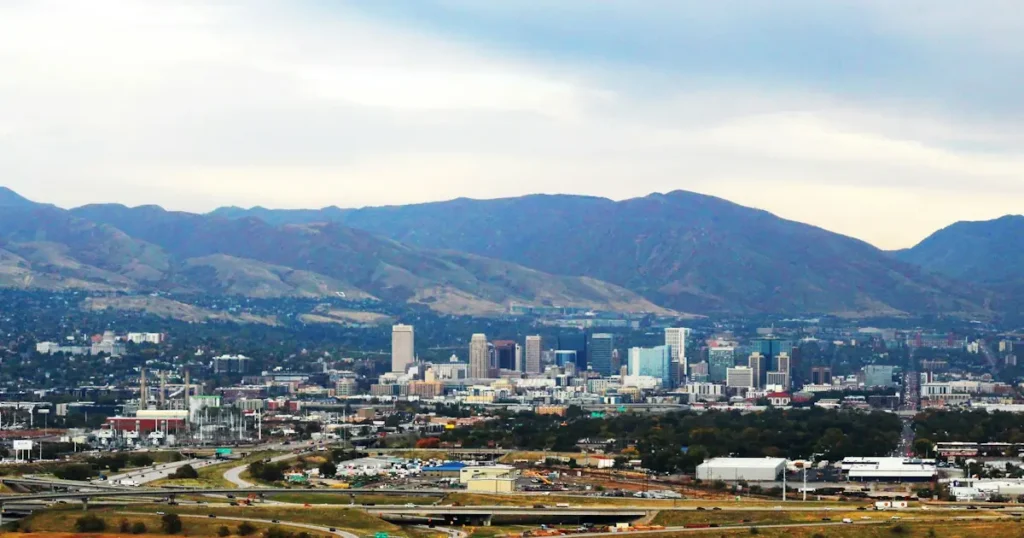
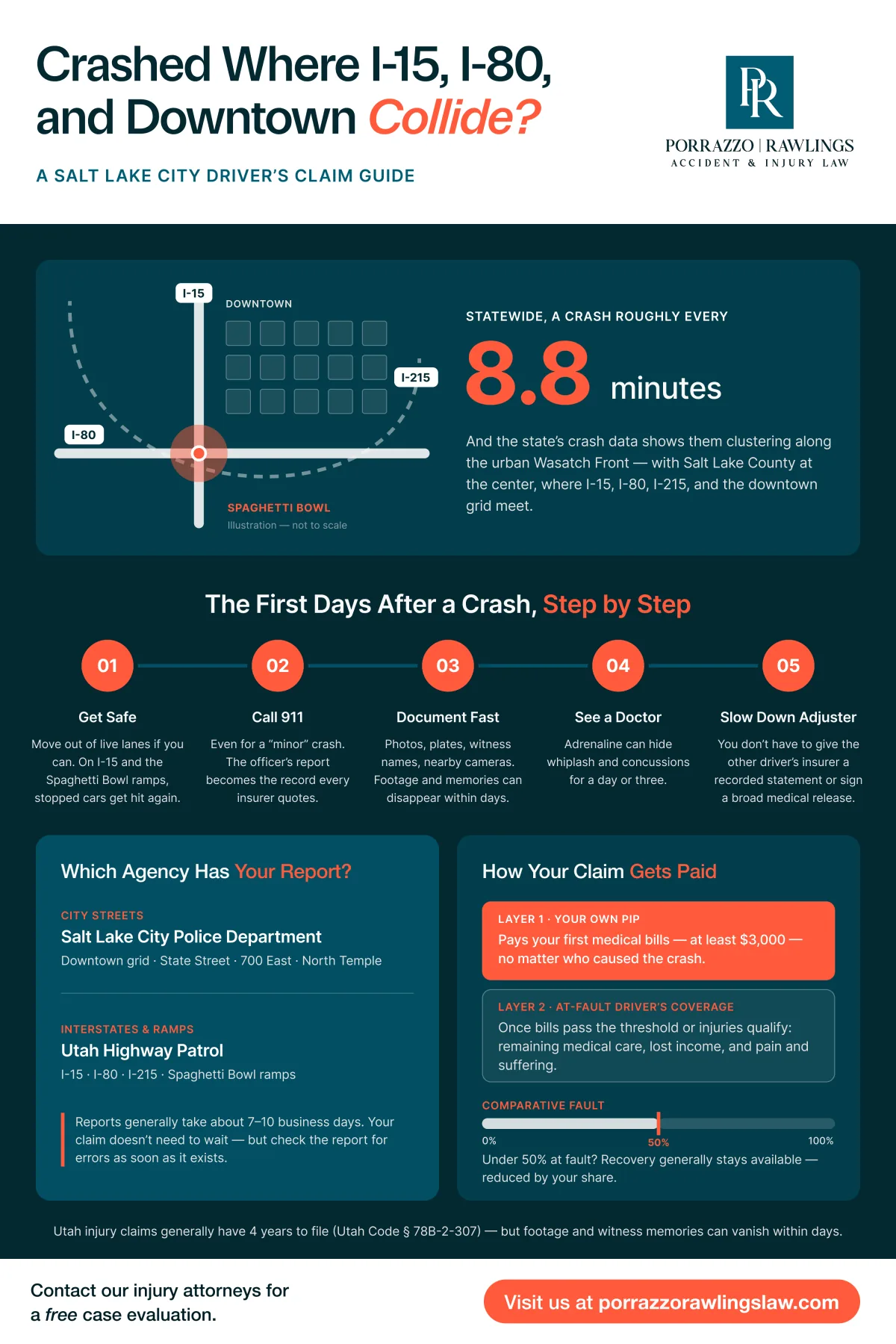
Salt Lake City concentrates more traffic into fewer square miles than anywhere else in Utah. The I-15/I-80 interchange south of downtown — the one everyone calls the Spaghetti Bowl — moves hundreds of thousands of vehicles a day. The downtown grid stacks commuters, delivery vans, rideshares, and visitors onto wide streets with long signal cycles. Add I-215’s loop, the 400 South and State Street arterials, North Temple, and Foothill Drive funneling canyon traffic, and you get the state’s densest crash map: statewide, Utah recorded a crash roughly every 8.8 minutes in 2024, and the state’s own data shows those crashes clustering heavily along the urban Wasatch Front — with Salt Lake County at the center of it.
If you were hurt in a Salt Lake City crash that wasn’t your fault, the steps you take in the first hours and days shape everything that follows. Here’s the full sequence.
Quick Answer: What should I do after a car accident in Salt Lake City? After a Salt Lake City crash: move out of travel lanes if you safely can, call 911, photograph vehicles and the scene, exchange insurance information, and request your crash report — from the Salt Lake City Police Department for city streets, or the Utah Highway Patrol for I-15, I-80, and I-215. Utah’s PIP coverage pays your first medical bills regardless of fault, and injured drivers who were less than 50% at fault generally have four years to bring a claim — but camera footage and witness memories in a dense urban corridor can disappear within days.
Step 1: Get Safe — Urban Crashes Have Second Acts
On the interstates, secondary collisions are the immediate danger: stopped vehicles in live lanes of I-15 or the Spaghetti Bowl ramps get hit again. If your car moves, get it to a shoulder or off the next exit; if it doesn’t, stay belted with hazards on until help arrives. Downtown, the risk is different — intersections stay live around you, so move the exchange of information onto a sidewalk or parking lane, not the middle of 400 South.
Call 911 even for a “minor” crash. Utah requires reporting crashes involving injury or significant damage, and the responding officer’s report becomes the first official record — the document every insurer will quote later.
Step 2: Document a Scene That Won’t Sit Still
Urban evidence is rich but short-lived. In the minutes after the crash:
- Photograph every vehicle, plate, and the surrounding roadway — including signals, lane markings, and anything (a delivery truck, a blocked lane, sun glare direction) that shaped what happened.
- Collect witness names and numbers immediately. Downtown witnesses walk away in ninety seconds.
- Note nearby cameras. The downtown core, TRAX corridors, and business districts are saturated with them — UDOT traffic cameras on the interstates, transit cameras, and private storefront systems — but retention windows are short, and footage requests need to move fast.
- Say little to the other driver beyond the exchange of information. “I didn’t even see you” reads as an admission in a claim file.
Step 3: Know Which Agency Holds Your Report
Jurisdiction decides where your crash report lives. City streets — the downtown grid, State Street, 700 East, North Temple — are typically Salt Lake City Police Department territory. The interstates and their ramps — I-15, I-80, I-215, and the Spaghetti Bowl — are usually worked by the Utah Highway Patrol, with statewide records maintained through the Utah Department of Public Safety. Reports generally take about 7–10 business days; your claim doesn’t need to wait for the paper, but the report should be reviewed for errors as soon as it exists.
Step 4: Medical Care and Utah’s PIP Rules
See a doctor promptly even if you walked away feeling fine — adrenaline hides whiplash and concussions for a day or three, and our guide to delayed injury symptoms after a crash explains why “I felt fine at the scene” is the most common sentence in Utah claim files.
Payment works in layers. Utah’s no-fault Personal Injury Protection (PIP) coverage on your own policy pays your first medical bills — a minimum of $3,000 — regardless of who caused the crash. Once bills pass that threshold or your injuries qualify, the claim steps outside the no-fault system and proceeds against the at-fault driver’s liability coverage for the rest: remaining and future medical care, lost income, and pain and suffering. Utah’s injury statute of limitations, Utah Code § 78B-2-307, generally allows four years — but in a camera-dense city, the evidence that wins disputed claims lives on a much shorter clock.
Step 5: The Adjuster Calls Faster Downtown
High-volume corridors mean high-volume claims operations, and the other driver’s insurer often calls within a day or two. Three ground rules: you’re not required to give a recorded statement to the other side’s insurer; don’t sign open-ended medical release forms; and treat an early settlement offer as what it is — a number priced before your injuries have finished appearing. Once a release is signed, the claim is closed for good, surgery or no surgery.
If fault is disputed — and in multi-lane interchange crashes it usually is — this is the point to bring in a Salt Lake City car accident attorney who can secure interchange camera footage, event-data-recorder downloads, and witness statements while they still exist, and deal with the insurer so you can deal with recovery. Wondering about cost? Our plain-answer guide to what an auto accident attorney in Utah actually costs covers it: nothing up front, and nothing at all unless the case wins or settles.
Why Fault Disputes Are Different in the City
Salt Lake City crashes generate the state’s most contested fault questions: lane-change disputes in the Spaghetti Bowl’s weaves, left turns across wide downtown intersections, one-way grid confusion catching visitors, and merge conflicts where I-80 traffic joins I-15. Utah’s comparative negligence rule means every percentage point of blame shifted onto you cuts your recovery by the same amount — recovery stays available as long as you’re under 50% at fault — so insurers work those percentages hard. The counterweight is evidence: signal timing, camera angles, damage geometry, and data. The state’s crash statistics from the Utah Highway Safety Office confirm what SLC drivers already know — following too closely and failure to yield lead the contributing factors, and both are provable behaviors, not mysteries.
A Local Firm for the State’s Busiest Roads
Porrazzo Rawlings Accident & Injury Law was built on one promise: big firm settlements with small firm personal attention. Our attorneys have recovered hundreds of millions of dollars for injured Utahns, and we deliberately limit our caseload so you’re never a case number — you work directly with a real attorney from the first call until your check is in hand, never handed off to a paralegal or case manager. Several of our attorneys are former insurance adjusters and insurance defense lawyers; when a carrier tries to shave 30% of the blame onto you for a Spaghetti Bowl merge, we’ve seen that playbook from the inside. For the statewide framework these claims run on, see our overview of how car accident claims work across Utah.
Frequently Asked Questions
Who investigates a crash on I-15 or I-80 in Salt Lake City? Usually the Utah Highway Patrol, with records flowing through the state’s Department of Public Safety. Crashes on city streets are typically documented by the Salt Lake City Police Department. The responding agency determines where you request your crash report.
The crash happened in the Spaghetti Bowl and three insurers are calling. Do I have to talk to them? You’re not required to give any of them a recorded statement, and in a disputed multi-vehicle interchange crash you shouldn’t — not before understanding how fault is being assigned. Direct them to your attorney once you have one.
Does Utah’s no-fault rule mean I can’t sue the at-fault driver? No. PIP pays your initial medical bills regardless of fault, but once your bills exceed the threshold or you suffer a qualifying injury, you can pursue the at-fault driver’s insurer for full damages — medical care, lost wages, and pain and suffering.
How much does a consultation cost? Nothing. Consultations are free, and we work on contingency with a zero-fee guarantee: you pay nothing unless we win or settle your case, and we advance all case costs.
Injured in Salt Lake City? Get Answers Today — Free
If a negligent driver hurt you anywhere from the downtown grid to the I-215 loop, get your questions answered before the insurers lock in their version. Call (801) 553-0505 to speak directly with an attorney — free consultations, available 24/7, and our car accident team in Salt Lake City will come to you, home or hospital, anywhere in the valley.
Disclaimer: This article is for informational purposes only and does not constitute legal advice. Reading this article does not create an attorney-client relationship. Every case is different, and no guarantees or promises can be made regarding the outcome of any claim or the amount of any compensation. Past results do not guarantee future outcomes. If you have been injured, consult directly with a qualified Utah attorney about your specific situation.