
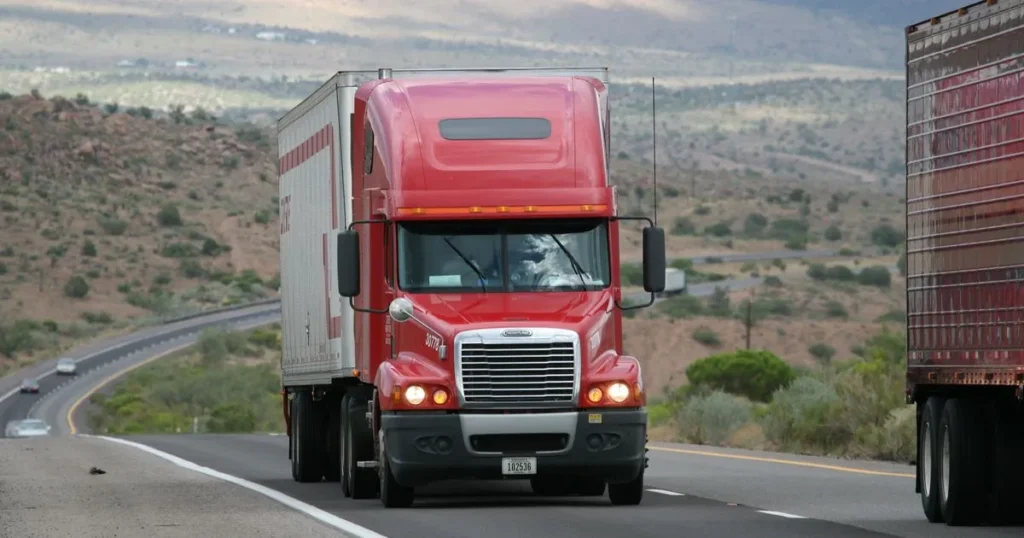
A truck accident in Salt Lake City can involve almost any kind of commercial vehicle, because almost every kind operates here. SLC is the Intermountain West’s freight hub: long-haul semis running I-15 and I-80 through the middle of the city, distribution traffic saturating the 2100 South and California Avenue industrial corridors, airport cargo cycling along I-80’s west side, and an endless rotation of delivery vans and box trucks working the downtown grid. When one of them causes a crash, the claim that follows depends heavily on which kind of truck, whose truck, and how fast the evidence gets preserved. This guide maps all three.
Quick Answer: What should I do after a truck accident in Salt Lake City? Photograph the truck’s company markings, USDOT number, and plates (tractor and trailer); get medical care the same day — Utah’s PIP coverage pays initial bills regardless of fault; report the crash (Utah Highway Patrol typically works the interstates, Salt Lake City Police the surface streets); decline recorded statements to the carrier’s insurer; and have a formal evidence-preservation letter served on the trucking company within days — its logs, camera footage, and onboard data run on short retention cycles. Commercial claims routinely involve multiple liable parties and higher insurance layers than car crashes.
Where SLC’s Truck Crashes Concentrate
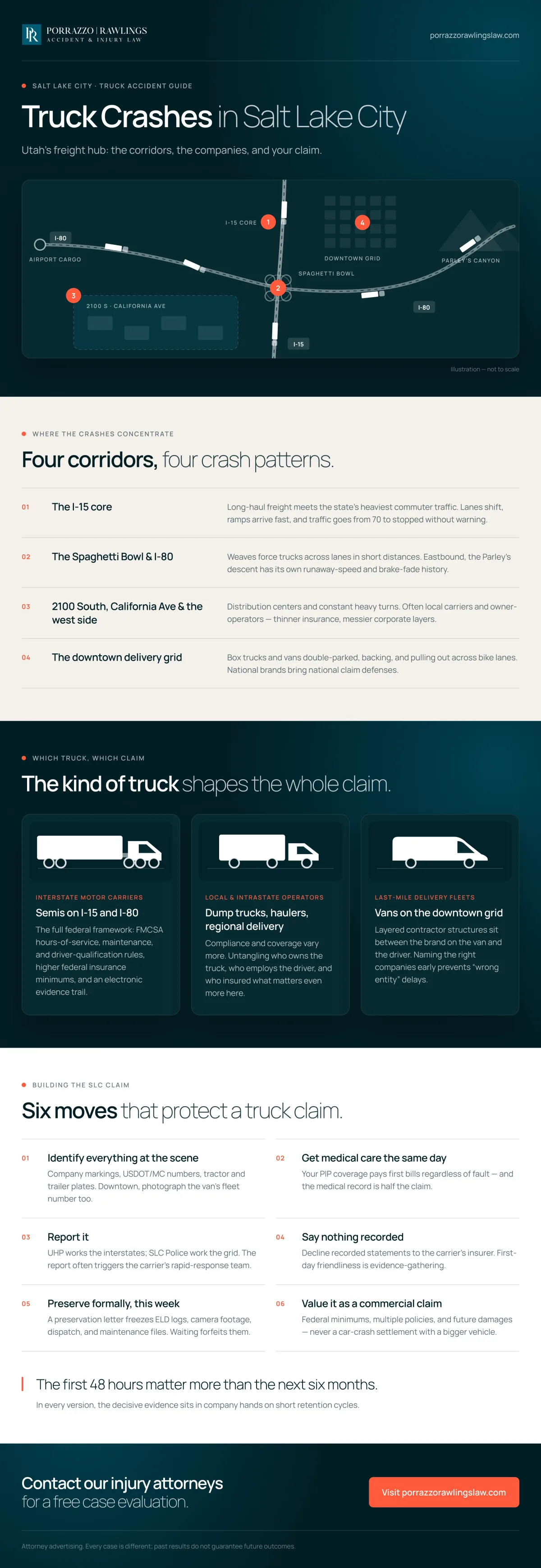
The I-15 core. The urban stretch between the interchanges compresses long-haul freight into the state’s heaviest commuter traffic — lane counts change, ramps arrive fast, and traffic goes from 70 to stopped without warning. The rear-end and lane-change patterns here are the classic ones, and the stakes rise with the weight differential.
The Spaghetti Bowl and I-80. Weaves and splits force trucks across multiple lanes in short distances. Westbound, I-80 carries freight toward the airport logistics parks; eastbound, it climbs Parley’s — where runaway-speed and brake-fade issues on the descent have their own grim history.
2100 South, California Avenue, and the industrial west side. Distribution centers, intermodal traffic, and constant heavy-vehicle turns across arterial traffic. Crashes here often involve local carriers and owner-operators — smaller companies, thinner insurance, and messier corporate layers than national fleets.
The downtown delivery grid. Box trucks and vans double-parked, backing, and pulling out across bike lanes and traffic on the wide blocks. Delivery crashes look smaller than semi crashes and litigate bigger than people expect — national logistics brands bring national claim defenses.
The concentration isn’t impression; it’s arithmetic. Statewide crash data from the Utah Highway Safety Office shows commercial-vehicle crashes disproportionately represented among serious-injury events, and Salt Lake County — where the freight network converges — carries the volume.
Which Truck Determines Which Claim
Interstate motor carriers (the semis) operate under the full federal framework — FMCSA hours-of-service, maintenance, and driver-qualification rules — with the higher federal insurance minimums and the electronic evidence trail we’ve detailed in our guide to truck black box and driver log evidence. Violations are provable, coverage is layered, and the defense is professional from hour one.
Local and intrastate operators — dump trucks, construction haulers, regional delivery — bring more variable compliance and coverage. The corporate untangling (who owns the truck, who employs the driver, who insured what) is often more important in these claims, not less.
Last-mile delivery fleets add their own wrinkle: layered contractor structures between the brand on the van and the driver behind the wheel. Identifying the correct corporate defendants early prevents the “wrong entity” delays these claims are known for.
In every version, the constants hold: the decisive evidence sits in company hands on short retention cycles, and the first 48 hours matter more than the next six months — the full checklist is in our first-48-hours truck playbook.
Building the SLC Claim
- Identify everything at the scene — company markings, USDOT/MC numbers, tractor and trailer plates, and the driver’s carrier information. Downtown, photograph the van’s fleet number too; contractor structures hide behind them.
- Medical care, same day. Utah’s PIP pays first bills regardless of fault; truck-crash energy hides injuries behind adrenaline, and the medical record is half the claim.
- The report. UHP for the interstates, SLC Police for the grid — the report anchors the file, and in commercial crashes it often triggers the carrier’s own rapid-response team.
- Say nothing recorded to the carrier’s insurer. Their first-day friendliness is evidence-gathering.
- Preserve, formally, this week. ELD logs, camera footage, dispatch records, maintenance files — a preservation letter served on the right entities freezes them; waiting forfeits them.
- Value the claim as a commercial claim. Federal minimums, multiple policies, and future-damages arcs make truck claims a different valuation exercise — never a car-crash settlement with a bigger vehicle attached.
Executing that sequence while injured is exactly what a truck accident attorney in Salt Lake City is for: preservation demands out in days, the corporate layers mapped, and the carrier’s claims operation matched from the first phone call. For the statewide legal framework these claims run on — federal regulations, layered liability, valuation — our Utah truck accident practice covers the full architecture.
Behind all of it: Porrazzo Rawlings Accident & Injury Law brings more than 100 years of combined experience and a deliberately limited caseload — the same attorney from day one until your check is in hand, no paralegal triage. Bill Rawlings is a former insurance adjuster and insurance defense lawyer; in commercial claims, where the other side runs a professional playbook, having someone who used to run it is the point.
Frequently Asked Questions
The truck that hit me was a delivery van, not a semi. Is it still a “truck claim”? Functionally, yes. Commercial-vehicle claims turn on company liability, corporate insurance, and employer responsibility regardless of vehicle size — and national delivery brands defend claims as professionally as any motor carrier. Identify the fleet and contractor details early.
Who investigates truck crashes on I-15 through Salt Lake City? Usually the Utah Highway Patrol, with serious commercial crashes sometimes drawing dedicated investigation units. Surface-street crashes belong to Salt Lake City Police. The investigating agency’s report is the claim’s anchor document either way.
The trucking company’s insurer called me the day after the crash. Is that normal? Completely — and strategic. Carriers deploy rapid-response protocols within hours. You’re not required to give a recorded statement, and declining until you have representation is the standard protective move.
What does hiring a truck accident attorney cost? Nothing up front. Consultations are free, and we work on contingency with a zero-fee guarantee — you pay nothing unless we win or settle — with all case costs advanced, including the preservation and reconstruction work commercial claims demand.
Hit by a Commercial Truck in SLC? Their Team Is Already Working — Free Consultation
From the I-15 freight lanes to a downtown delivery block, the company’s evidence is on a deletion schedule right now. Call (801) 553-0505 to speak directly with an attorney today — free consultations, available 24/7 — and our truck accident team serving Salt Lake City will get the preservation demands moving before the record turns over.
Disclaimer: This article is for informational purposes only and does not constitute legal advice. Reading this article does not create an attorney-client relationship. Every case is different, and no guarantees or promises can be made regarding the outcome of any claim or the amount of any compensation. Past results do not guarantee future outcomes. If you have been injured, consult directly with a qualified Utah attorney about your specific situation.