

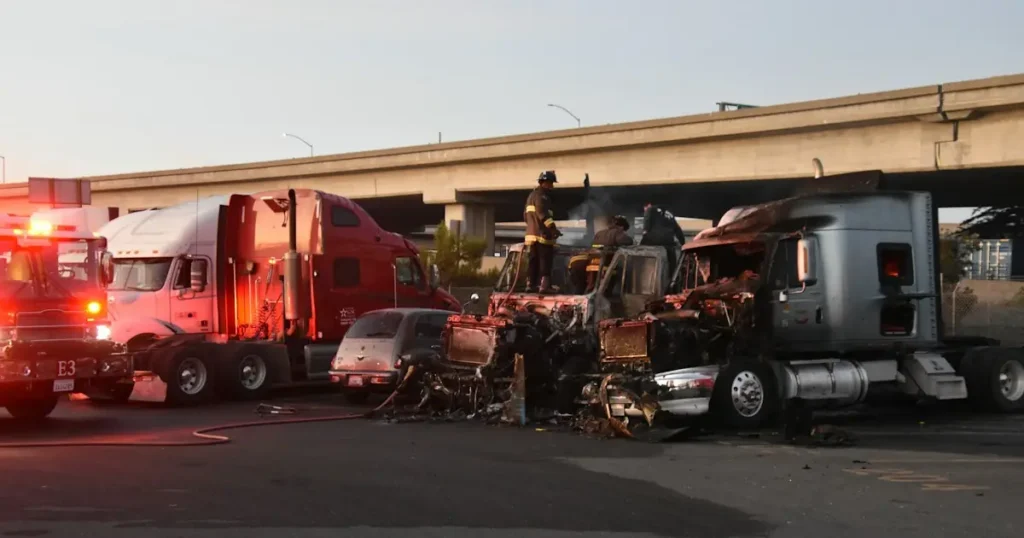
While you’re waiting for the tow truck, the motor carrier’s insurer may already be assigning your crash a claim number. Serious commercial crashes trigger rapid-response protocols — investigators dispatched to scenes, adjusters briefed, counsel looped in — sometimes within hours of impact. That’s not paranoia; it’s how the industry manages risk, and it means the first 48 hours after a semi crash are the least equal playing field in injury law.
They can’t be gotten back, but they can be used well. Here’s the working checklist for an injured Utah driver’s first two days — what to capture, what to decline, and which single piece of paper matters most.
Quick Answer: What should I do in the first 48 hours after a semi truck accident in Utah? Hour one: get medically evaluated even if you feel functional, and photograph the truck’s company markings, USDOT number, and the full scene if you’re able. Day one: report the crash to your own insurer, decline recorded statements to the carrier’s insurer, and write down everything you remember. Day two: get a formal evidence preservation letter served on the motor carrier and its insurer — the truck’s logs, camera footage, and onboard data run on short retention cycles, and federal post-accident drug and alcohol testing records exist only if the crash qualified and someone follows up. Early attorney involvement makes all of this one phone call.
Hours 0–2: The Scene (If You’re Physically Able)
Health first, always — nothing below outranks the ambulance. But if you’re mobile and safe:
- Photograph the truck’s identity: cab markings, USDOT and MC numbers, license plates (tractor and trailer), and any placards. Corporate layers — who owns the tractor, who employs the driver, who brokered the load — get untangled later from exactly these details.
- Photograph the whole scene: vehicle positions before they move, skid marks, debris fields, road and weather conditions, and your own vehicle from every angle.
- Collect witnesses. Drivers who saw the truck weaving, tailgating, or speeding before impact are gold — and gone in minutes.
- Tell responding officers everything honestly, including “I’m not sure yet” about injuries. On Utah’s freight corridors the Utah Highway Patrol typically works these scenes, with records flowing through the Utah Department of Public Safety; the officer’s report becomes the claim’s first anchor document.
- Exchange information, volunteer nothing. No fault speculation, no apologies, no “I’m fine.”
One more thing happens at qualifying crash scenes that most drivers never learn: federal rules require motor carriers to conduct post-accident drug and alcohol testing of their drivers after certain crashes — the FMCSA’s testing regulations define when. Whether that testing happened, and what it showed, becomes discoverable evidence. It’s one more record your side should be tracking from day one.
Hours 2–24: Medical Care and First Contacts
Get evaluated the same day — full stop. Truck-crash energy produces injuries that adrenaline hides: soft-tissue damage, concussions, internal injuries that declare themselves on day two or three. A same-day exam protects your health and starts the medical record that connects everything that follows to the crash. Utah’s PIP coverage pays your first medical bills — minimum $3,000 — regardless of fault, so cost is never the reason to wait.
Report to your own insurer. Prompt notice is a policy obligation. Keep it factual — what, where, when — and skip recorded narrative theatrics even with your own carrier.
Expect the other side’s call — and decline it. The carrier’s insurer often reaches out within the first day, friendly and fast, asking for “just your side of the story” on a recorded line. You are not required to give it, and you shouldn’t: that call is an evidence-gathering exercise for their file, and we’ve dissected it line by line in our guide to what to do when the trucking company calls after your crash.
Write your own account tonight. Times, lanes, speeds, what the truck did, what you did, what was said at the scene. Memory is evidence, and it degrades on a schedule of its own.
Hours 24–48: The Preservation Letter — the Two-Day Task That Outweighs Everything
Everything the truck knows about your crash — electronic driver logs, engine data from the seconds before impact, dash-camera footage, dispatch records, maintenance files — sits in the carrier’s possession, on routine retention cycles that quietly erase it. Camera footage can overwrite in days; federal rules set the hours-of-service retention floor at just six months; salvaged tractors take their data modules with them.
The counter is a formal preservation (spoliation) letter served on the motor carrier and its insurer, identifying every category of evidence to be held. Once served, destroying covered evidence exposes the carrier to sanctions that can reshape a case — which is why sophisticated carriers comply. We’ve mapped what each record proves in our companion deep-dive on truck black box and driver log evidence; the 48-hour point is simpler: the letter has to exist before the retention cycles turn.
Realistically, this is the step that brings representation forward. A preservation demand needs the right categories, the right corporate entities, and same-week service — and it’s the first-day work of truck accident attorneys serving Provo, Salt Lake City, and all of Utah. Consultations are free and available 24/7, which means the letter can be moving before your second doctor’s appointment.
What Not to Do in the First 48
- Don’t give any recorded statement to the carrier’s insurer, however friendly the ask.
- Don’t sign anything — not medical authorizations, not property-damage releases bundled with injury language, not “routine paperwork.”
- Don’t post about the crash anywhere. Claims teams read social media professionally.
- Don’t authorize your vehicle’s disposal until its own data and damage evidence are documented — your car’s event data recorder tells part of the story too.
- Don’t evaluate settlement talk. Any number floated in the first week is priced on the hope that you’ll take it before the injuries and the evidence are known.
Utah’s legal deadlines are generous by comparison — the general injury statute of limitations runs four years — but nothing about a truck claim’s evidence respects that calendar. The claim you can prove in month twelve is decided by what got preserved in week one.
Frequently Asked Questions
The trucking company’s investigator wants to inspect my car. Should I allow it? Not unilaterally. Vehicle inspections should be coordinated so your side documents the same evidence — ideally with your own representative involved. Your vehicle’s damage pattern and event data are part of your proof.
I feel mostly fine. Do I really need a medical exam in the first 48 hours? Yes. Delayed-onset injuries are the norm in high-energy crashes, and a same-day exam creates the record that ties later symptoms to the collision. “I felt fine at the scene” appears in almost every truck claim file — it only hurts the claims where nothing was documented afterward.
What if the crash was partly my fault? Utah’s comparative negligence rule preserves recovery as long as you were less than 50% at fault, with compensation reduced by your share. Expect the carrier to push fault percentages your way — and remember the truck’s own data usually answers the question better than anyone’s recollection.
What does getting an attorney involved this early cost? Nothing up front. Consultations are free, we work on contingency with a zero-fee guarantee — you pay nothing unless we win or settle your case — and we advance all case costs, including the preservation and data work the first week demands.
Their Team Started at the Scene. Start Yours Now — Free
Two days decide what a Utah truck claim can prove. Call (801) 553-0505 to speak directly with an attorney right now — free consultations, available 24/7 — and our Utah truck accident team will handle the preservation letter, the insurer contacts, and every next step while you handle recovery.
Disclaimer: This article is for informational purposes only and does not constitute legal advice. Reading this article does not create an attorney-client relationship. Every case is different, and no guarantees or promises can be made regarding the outcome of any claim or the amount of any compensation. Past results do not guarantee future outcomes. If you have been injured, consult directly with a qualified Utah attorney about your specific situation.