
Most fault disputes take weeks. A left turn accident fault in Sandy, Utah question usually takes one sentence: the turning driver had a duty to yield, and didn’t. Along Sandy’s wide arterials — State Street’s business-driveway gauntlet, the 9000 South and 10600 South corridors, the 700 East signal chain — left turns across oncoming traffic produce the city’s most common serious intersection crashes, and Utah law resolves most of them the same way. This guide covers the rule, the real exceptions, and how the claim works when a turning driver’s misjudged gap becomes your injury.
Quick Answer: Who is at fault in a left-turn accident in Sandy, Utah? In most cases, the left-turning driver. Utah law requires a driver turning left to yield the right of way to oncoming traffic that is close enough to be a hazard — so when a turning vehicle and a through vehicle collide, the presumption runs against the turner. The main exceptions: the through driver ran a red light, was traveling at an excessive, provable speed, or the turner had a protected green arrow. Utah’s comparative negligence rule can split fault in those cases, reducing recovery by each driver’s percentage.
The Rule: Oncoming Traffic Owns the Intersection
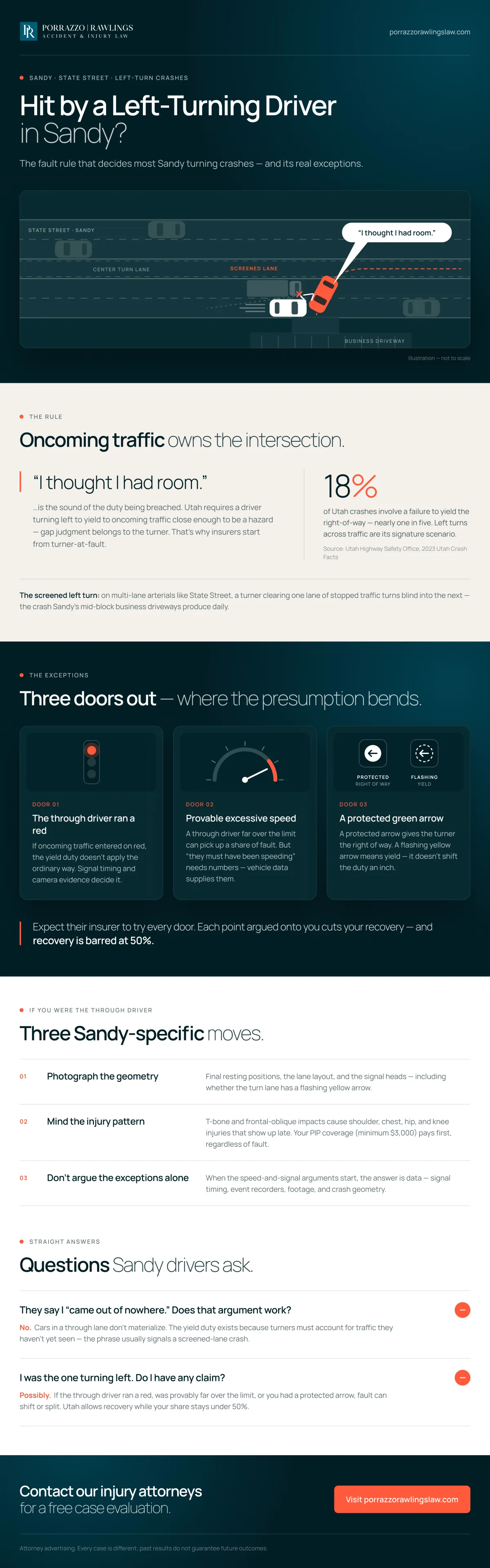
Utah’s yield-on-left requirement is one of the clearest duties in the traffic code: a left-turning driver must wait until the turn can be completed without forcing oncoming traffic to brake or swerve. “I thought I had room” is the sound of the duty being breached — gap judgment is precisely what the law assigns to the turner. That’s why, when insurers receive a left-turn claim, the internal starting point is turner-at-fault, and the litigation history behind that default is deep.
The pattern shows up in the numbers: failure to yield ranks among Utah’s top crash factors — nearly one in five statewide, per the Utah Highway Safety Office — and left-turns-across-traffic are its signature scenario. On multi-lane arterials like State Street, the risk compounds: a turner clearing one lane of stopped traffic turns blind into the next lane’s moving traffic — the classic “screened” left-turn crash that Sandy’s mid-block business driveways manufacture daily.
The Exceptions — Where the Presumption Bends
The turner-at-fault default isn’t absolute, and both sides’ insurers know the three doors out:
The through driver’s light. If oncoming traffic entered on a red, the yield duty never triggered against them in the ordinary way — signal timing and camera evidence decide it, the same proof stack that resolves red-light disputes.
Speed. A through driver traveling dramatically over the limit can pick up a comparative-fault share, because the turner’s gap judgment was made against lawful speeds. But “they must have been speeding” is an argument insurers assert far more often than the physics support — vehicle event data answers it with numbers.
Signal phase. A turner moving on a protected green arrow had the right of way; a turner on a permissive phase — including Utah’s now-ubiquitous flashing yellow arrows — did not. Flashing-yellow confusion has become its own crash genre on Wasatch Front arterials, and we’ve given it a full guide of its own for the southwest valley; the short version for Sandy: a flashing yellow means yield, and turning on one doesn’t shift the duty an inch.
If you were the through driver — the person hit — expect the other insurer to try each door before conceding the default. Utah’s comparative negligence rule is the lever: every percentage point argued onto you cuts your recovery by the same amount, with recovery barred at 50%. The counters are evidentiary, not rhetorical: signal data, EDR downloads, camera footage, and the crash geometry that shows where in the intersection — and in which lane — the impact landed.
The Claim, Sandy-Specific
The mechanics run on the same rails as any Sandy crash — our step-by-step Sandy crash guide covers the scene, the Sandy City PD report, and the adjuster rules — with three left-turn-specific emphases:
- Photograph the geometry. Final resting positions, the intersection’s lane layout, and the signal heads (including whether the turn lane has a flashing yellow arrow). Left-turn fault often lives in exactly these details.
- Mind the injury pattern. T-bone and frontal-oblique impacts produce shoulder, chest, hip, and knee injuries with delayed presentations — and Utah’s PIP coverage (minimum $3,000, fault-blind) means cost never justifies a delayed exam.
- Don’t negotiate against the exceptions alone. When the turning driver’s insurer starts the speed-and-signal arguments, that’s the moment a Sandy car accident attorney earns the fee that costs you nothing up front — assembling the data that holds the default where the facts put it.
One sibling scenario deserves its own mention: when the vehicle the turner failed to see was a motorcycle, everything above applies plus a bias layer — insurers price rider claims against stereotypes, and our guide to left-turn motorcycle crashes in Utah covers how that version gets dismantled.
The statewide machinery holds throughout: comparative negligence below 50%, the four-year statute of limitations under Utah Code § 78B-2-307, and the evidence clocks that run far faster than either. And behind the work, the same promise as every claim we take: more than 100 years of combined experience, a deliberately limited caseload, the same attorney from your first call until your check is in hand. Bill Rawlings is a former insurance adjuster; the left-turn exception playbook is one we’ve run from the other chair, which is why it doesn’t move us. The full framework lives at our overview of how car accident claims work across Utah.
Frequently Asked Questions
The turning driver says I “came out of nowhere.” Does that argument work? No. Vehicles on a through lane don’t materialize; the yield duty exists precisely because turners must account for oncoming traffic they haven’t yet seen. The phrase usually signals a screened-lane crash — a fault fact against the turner, not for them.
I was turning left and got hit. Do I have any claim at all? Possibly. If the through driver ran a red, was provably far over the speed limit, or you had a protected arrow, fault can shift or split. Utah’s comparative rule allows recovery as long as your share stays under 50% — these cases turn entirely on signal and speed evidence.
Does a flashing yellow arrow change who’s at fault in Sandy? No — a flashing yellow arrow is a permissive phase meaning yield to oncoming traffic. Turning on one carries the same duty as an ordinary green, and misreading it as protected is one of the most common left-turn crash causes on Utah arterials.
How much does it cost to have my left-turn claim evaluated? Nothing. Consultations are free, and we work on contingency with a zero-fee guarantee — you pay nothing unless we win or settle your case, with all case costs advanced.
Hit by a Left-Turner in Sandy? Hold the Default Where It Belongs — Free
The law already leans your way; the evidence keeps it there. Call (801) 553-0505 to speak directly with an attorney — consultations are free, we’re available 24/7, and our attorneys serving Sandy will come to you anywhere in the southeast valley.
Disclaimer: This article is for informational purposes only and does not constitute legal advice. Reading this article does not create an attorney-client relationship. Every case is different, and no guarantees or promises can be made regarding the outcome of any claim or the amount of any compensation. Past results do not guarantee future outcomes. If you have been injured, consult directly with a qualified Utah attorney about your specific situation.