
Bangerter Highway is the spine of the southwest Salt Lake Valley — and the birthplace of its most disputed accident injury claims. It carries South Jordan commuters past Daybreak, connects Riverton families to everything north, and funnels tens of thousands of vehicles a day through a corridor that UDOT has spent a decade rebuilding — first with continuous flow intersections, and now with freeway-style interchanges. All that engineering has made Bangerter faster. It has also made crashes on it legally messier than almost anywhere else in the county.
If you were hurt on Bangerter and the crash wasn’t your fault, this guide explains how a Bangerter Highway accident injury claim works, why the road’s unusual intersections create fault disputes, and what South Jordan and Riverton drivers should do to protect themselves.
Quick Answer: Who is at fault in a Bangerter Highway accident, and how does the injury claim work at a continuous flow intersection? Bangerter’s continuous flow intersections (CFIs) route left-turning traffic to the opposite side of the road before the main signal, and insurers often wrongly blame the turning driver by default. Fault actually depends on which driver violated their displaced signal — something Utah crash reports, signal-timing records, and intersection camera footage can establish. Because CFI fault is so frequently disputed, these claims benefit from attorney review before you accept any blame.
Why Bangerter Crashes Confuse Everyone — Including Insurers
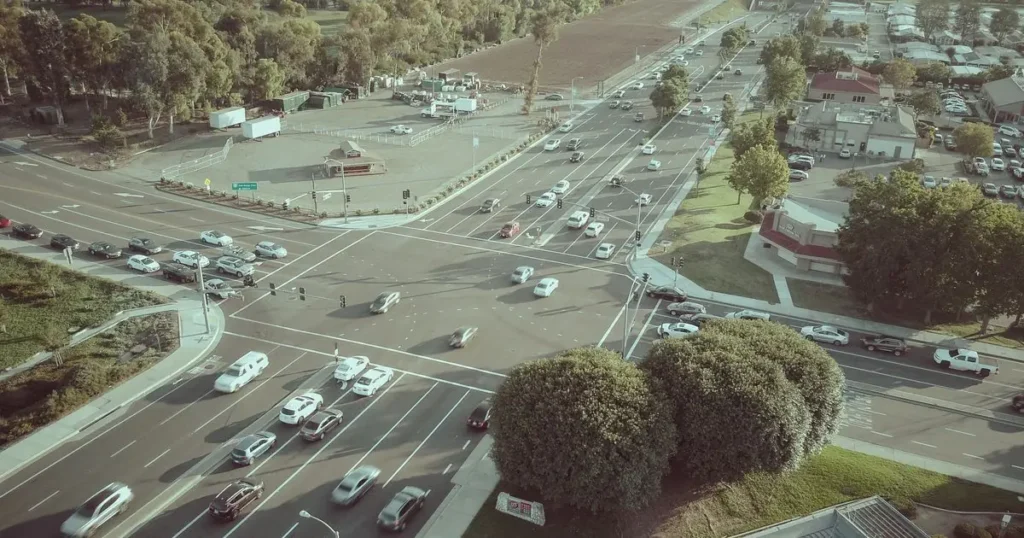
A conventional intersection gives everyone a shared mental model: green means go, left turns yield. A Bangerter continuous flow intersection accident breaks that model. At a CFI, left-turning vehicles cross oncoming traffic several hundred feet before the main intersection, then travel on the far left side of the road. Drivers unfamiliar with the design hesitate, stop where they shouldn’t, or run a displaced signal they didn’t recognize as theirs.
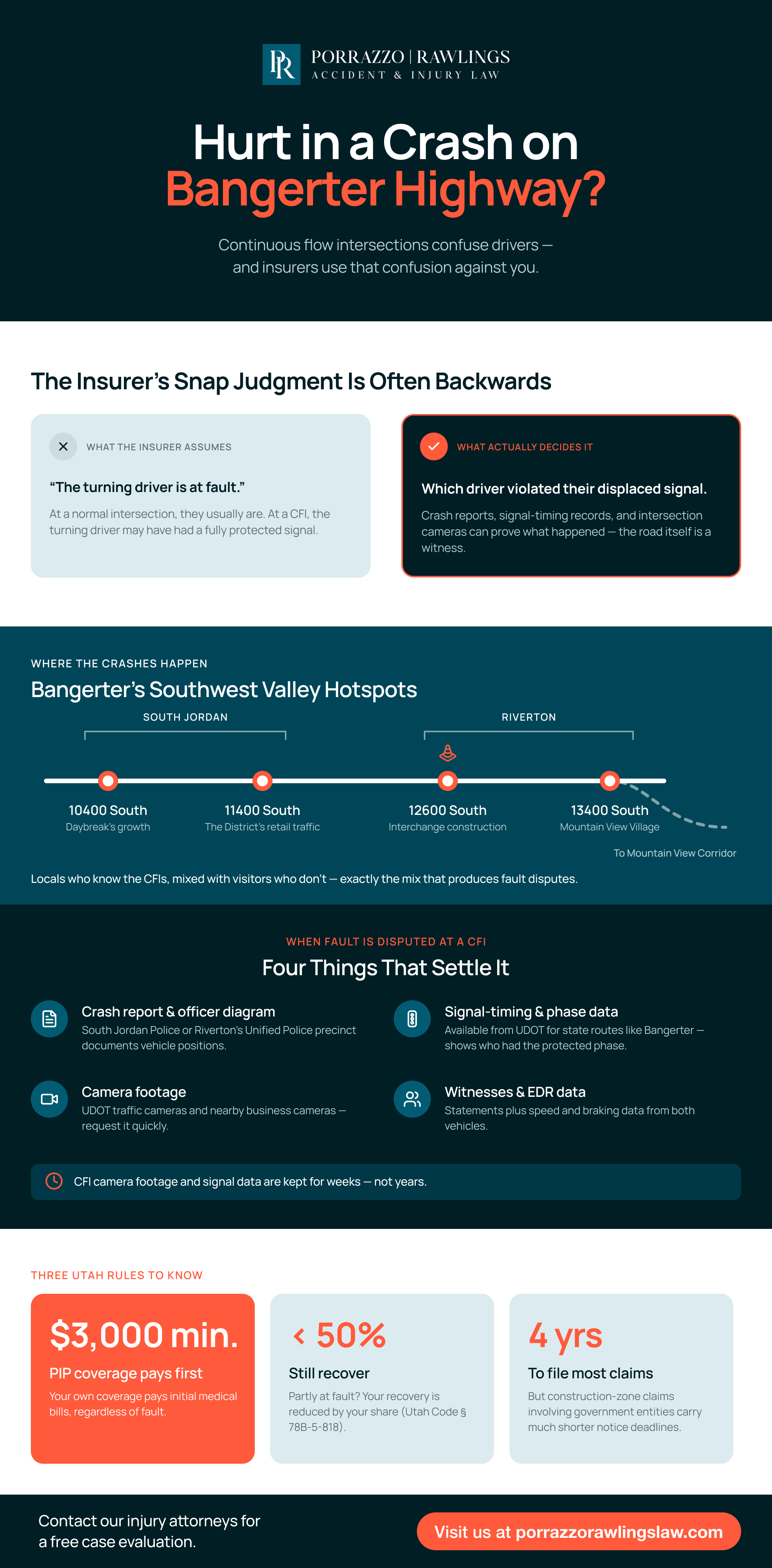
When a crash happens, here’s the pattern we see: the other driver’s insurance company assumes the turning driver must be at fault — because in a normal intersection, they usually are. At a CFI, that assumption is often exactly backwards. The turning driver may have had a fully protected signal while the through-driver ran a red they never registered.
Meanwhile, the corridor keeps changing. Interchange construction at 2700 West, 12600 South, and other crossings means shifted lanes, temporary signals, and new traffic patterns every few months — and construction-zone crashes add their own layer of questions about signage, barriers, and sometimes contractor responsibility.
The takeaway: on Bangerter, do not accept an insurer’s snap fault decision. The road itself is a defense witness — signal timing data, UDOT intersection cameras, and the physical geometry of the CFI can prove what actually happened.
What Utah Law Says About Disputed Fault
Utah follows modified comparative negligence: you can recover damages as long as you were less than 50% at fault, with your recovery reduced by your percentage. The statute behind this is Utah Code § 78B-5-818, and it’s the reason insurers contest fault percentages so aggressively, not just fault itself. Shaving 20% of blame onto you saves them 20% of the payout. Our Utah car accident practice page covers how these percentage battles play out across claim types.
Two more rules every South Jordan and Riverton driver should know:
- PIP pays first. Utah’s no-fault system means your own Personal Injury Protection coverage handles your initial medical bills — at least $3,000 — regardless of fault. Once bills exceed that threshold or you suffer a qualifying injury, you can pursue the at-fault driver’s insurer for everything else: remaining medical costs, lost wages, and pain and suffering.
- Four years, but don’t wait. Utah’s injury statute of limitations is generally four years, but CFI camera footage and signal data are retained on much shorter cycles. In a disputed-signal crash, the evidence that decides your case may exist for weeks, not years.
Where the Crashes Happen: South Jordan & Riverton Hotspots
South Jordan: the Bangerter crossings at 10400 South and 11400 South serve Daybreak’s growth and the District’s retail traffic. A Daybreak car accident on a Bangerter approach often involves exactly the mix that produces disputes — local drivers who know the CFIs and visitors who don’t.
Riverton: at the south end, Bangerter meets 12600 South and 13400 South near Mountain View Village, and connects across to Mountain View Corridor — a newer highway with its own rapidly evolving intersections. A Mountain View Corridor crash claim raises the same themes: unfamiliar road design, ongoing construction, and insurers defaulting to easy fault stories.
Crash concentration along these growth corridors isn’t anecdote — the Utah Department of Public Safety’s crash data consistently shows the state’s crashes clustering on high-volume arterials exactly like Bangerter.
When Fault Gets Disputed at a CFI: Your Move
If the adjuster tells you “our insured had the green” or “left-turning drivers are presumed at fault,” treat that as an opening position, not a verdict. Here’s what actually resolves a disputed CFI crash:
- The crash report and officer diagram — South Jordan Police or Riverton’s Unified Police precinct will document vehicle positions that often contradict the insurer’s story.
- Signal-timing and phase data — obtainable from UDOT for state routes like Bangerter, showing which movement had a protected phase at the moment of impact.
- Camera footage — UDOT traffic cameras and nearby business cameras, which must be requested quickly.
- Witness statements and vehicle EDR data — speed and braking data from both vehicles.
Assembling that record is exactly the work a South Jordan car accident lawyer does in the first weeks of a disputed-fault claim — and it’s why early involvement changes outcomes. Once an insurer commits to a fault position in writing, moving them requires evidence they can’t argue with.
What Your Claim Can Include
If another driver’s negligence injured you on Bangerter, a complete claim accounts for far more than the ER bill: all crash-related medical treatment (including future care), lost income and reduced earning capacity, out-of-pocket costs, and pain and suffering. No attorney can promise what any specific claim is worth — and you should be skeptical of anyone who does. What matters is that nothing gets left out, because once you sign a release, the claim is closed for good.
The Porrazzo Rawlings Difference for Southwest Valley Drivers
Our approach is built on a simple idea: big firm settlements with small firm personal attention. We’ve recovered hundreds of millions of dollars for injured Utahns, but we deliberately keep our caseload limited so that you are never just a case number. From your first call to your final check, you work directly with a real attorney — never handed off to a paralegal or case manager. In a disputed CFI case, that continuity matters: the attorney negotiating with the insurer is the same one who studied your signal data and walked your intersection.
And because several of our attorneys are former insurance adjusters and defense lawyers, we know the “turning driver is always at fault” playbook from the inside — and how to dismantle it.
Frequently Asked Questions
The insurance company already said I was at fault at a CFI. Is it over? No. Initial fault decisions are routinely revised when signal data, camera footage, or reconstruction evidence contradicts them. Don’t sign anything, and get the decision reviewed.
Does construction on Bangerter change who’s responsible? It can. Confusing temporary signage, misplaced barriers, or negligent traffic control can add contractor or governmental liability questions — with much shorter notice deadlines than the standard four-year statute. If construction played a role in your crash, get advice quickly.
I live in Riverton — do you handle crashes on Mountain View Corridor too? Yes. Riverton drivers can start with our Riverton car accident team — same attorneys, same zero-fee guarantee, for every road in the southwest valley.
Talk to an Attorney About Your Bangerter Crash — Free
If you were injured on Bangerter Highway, at a CFI, or anywhere in South Jordan or Riverton, don’t let an insurer’s assumption become your outcome. Call (801) 553-0505 to speak directly with an attorney about a car accident claim in South Jordan — the consultation is free, we’re available 24/7, and with our zero-fee guarantee you pay nothing unless we win or settle your case. We’ll come to you, anywhere in the Salt Lake Valley.
Disclaimer: This article is for informational purposes only and does not constitute legal advice. Reading this article does not create an attorney-client relationship. Every case is different, and no guarantees or promises can be made regarding the outcome of any claim or the amount of any compensation. Past results do not guarantee future outcomes. If you have been injured, consult directly with a qualified Utah attorney about your specific situation.