
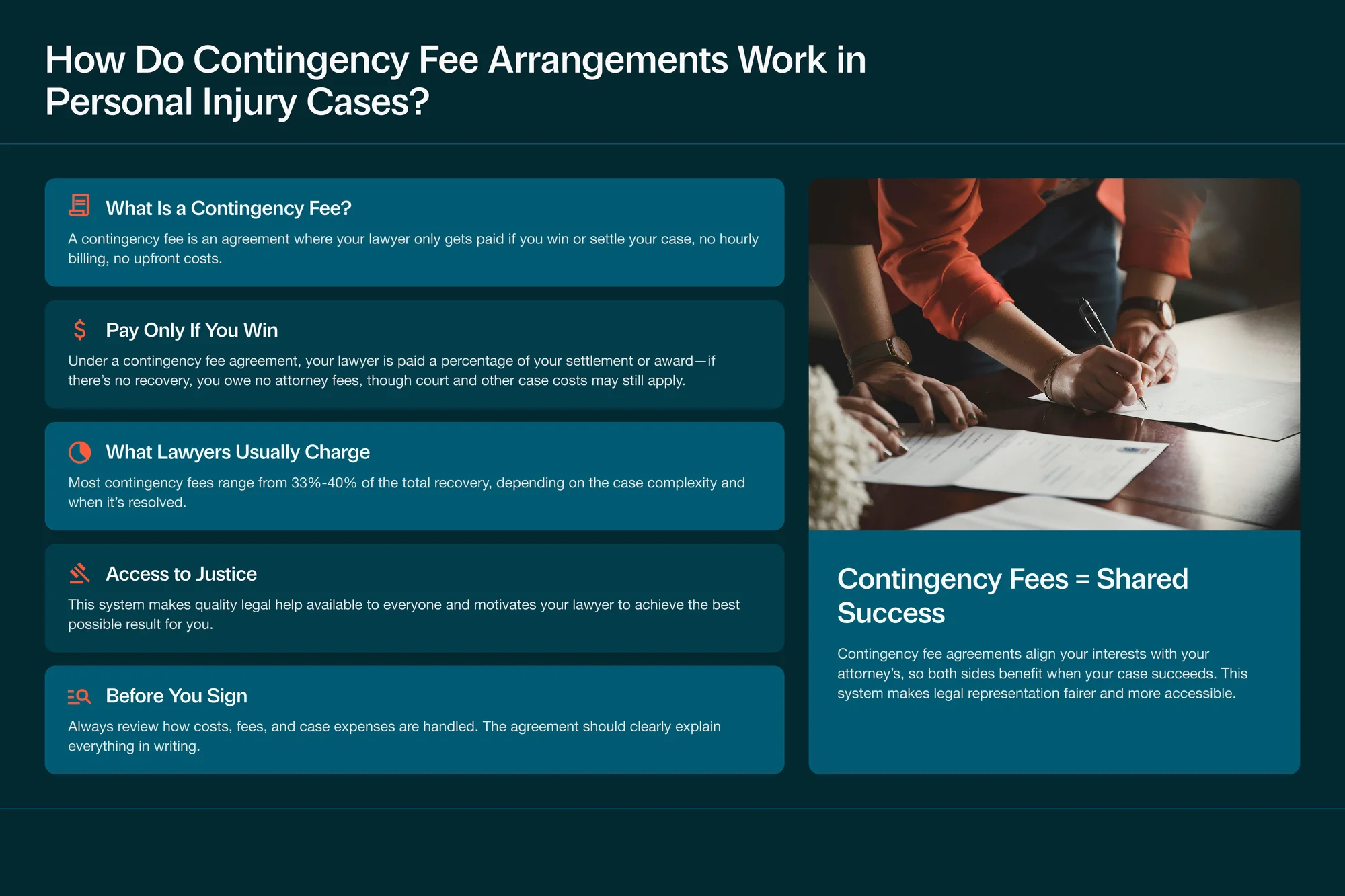
If an individual is injured due to the negligence of another, hiring a personal injury lawyer can be an important step towards seeking compensation. Legal representation, however, raises concerns over costs. The majority of personal injury lawyers utilize contingency fee agreements that allow clients to sue without having to pay upfront for legal fees. An understanding of how they operate is important for any party considering litigation after an accident.
What Is a Contingency Fee Agreement?
A contingency fee agreement is a payment arrangement in which the attorney only receives a fee when the client wins and recovers damages. Unlike hourly or flat-fee arrangements, clients do not pay for legal services unless the case resolves or a court judgment is awarded.
According to Cornell Law, “in a contingent fee agreement, the lawyer is paid only if the lawyer has succeeded on behalf of the client. Moreover, the payment received by the lawyer is based on what the lawyer attains by way of outcome and often by way of stage of litigation on which the case is settled.” This type of agreement is particularly common in the case of personal injury, where lawyers are typically paid 20% to 50% of the recovery amount.
Normally, the fee is a percentage of the recovery, usually 25% to 40%, varying with the complexity of the case, the resolution stage, and the arrangement with the attorney. For instance, if a client is awarded a $50,000 settlement and the attorney’s contingency fee is 33%, the attorney would take home around $16,500.
This tactic provides access to lawyers for those who might otherwise be unable to afford them, and it brings the lawyer’s interests into alignment with the client’s: both of them profit from the successful outcome of their case.
How Payments Are Made
Contingency fees are usually taken after the client has been paid. There are some standard structures:
Single Percentage Fee: One percentage of the total recovery is negotiated at the beginning.
Sliding Scale: The percentage is adjustable depending on whether the case settles or goes to trial. Trials usually involve a higher percentage due to increased time, risk, and expense.
Shared Costs: In some agreements, lawyer fees such as filing fees, expert fees, and deposition fees will be deducted from the client’s portion of the settlement or award, or will be handled independently.
It should be essential that clients fully comprehend the fee arrangement and how costs are handled before they sign any agreement. A contingency fee agreement, according to Model Rules of Professional Conduct 1.5(c), must be in writing, explain how the fee will be calculated, and include any costs for which the client will be responsible.
Benefit of Contingency Fee Arrangements
There are several benefits to clients pursuing personal injury claims via contingency fees:
- No Advance Fee Required: Clients can pursue claims without paying hourly attorney rates. This is especially helpful for individuals dealing with medical bills or lost income resulting from an injury.
- Risk Sharing: Attorneys share some risk because they get paid only if the case is won. This gives attorneys an incentive to perform diligently to win a good result.
- Access to Legal Representation: Individuals who cannot possibly pay for an attorney financially may still recover against negligent parties.
Proponents note that contingency fees facilitate clients who could not otherwise pay for legal representation, motivate attorneys to strive for success, and allow clients to shift the risk of loss to the attorney.
These benefits make contingent arrangements the most common method of handling personal injury cases, including car accidents, slip-and-fall injuries, medical malpractice, and workplace accidents.
Probable Drawbacks
As convenient as contingency fee agreements provide, there are certain things the client needs to be aware of:
- Higher Cost if Successful: Where the client wins a big award, the attorney’s share is a handsome amount.
- Liability for Costs: According to the agreement, the client may be liable for some costs even in the case of a losing case.
- Partial Control Over Outcome: Attorneys can resolve cases to optimize the overall recovery but will not always have his/her own personal option.
Critics suggest that contingency fees can contribute to frivolous lawsuits, encourage attorneys to accept less money than a case is worth quickly, and sometimes result in fees that are excessive in relation to the risk of the attorney.
It is necessary that clients bring these elements to their lawyer’s attention and ensure they clearly understand the monetary elements in advance.
Situation Where Contingency Fees are Most Prevalent
Contingency fees are most often applied in situations where:
- The client lacks the ability to afford hourly lawyer fees: Lawyering services are also available to economically disadvantaged clients.
- The case has dubious outcomes: Attorneys are able to accept cases of dubious outcome since they have faith in the client’s case.
- The case is able to recoup significant amounts of money: High-sum cases always justify the contingency provision to both attorney and client.
On the other hand, small claims or cases with minimal recovery that is expected might be less suitable for contingency arrangements because the attorney’s fees will not be paid by the expected settlement.
Questions to Ask Prior to Signing a Contingency Fee Contract
Clients must always ask simple questions prior to signing a contingency fee contract. Some of the important questions include:
- What percentage of the recovery will the attorney get if the case settles by agreement versus trial?
- Are there going to be any charges or fees that the client will be charged regardless of what the outcome is?
- How will expenses be handled if the case is lost?
- Are there any circumstances under which the contingency fee might have to be negotiated?
Getting the answers in writing makes it clear and avoids confusion later.
Knowing Your Legal Options
Contingency fee contracts allow hurt clients to access justice without incurring money in advance. The contracts promote a partnership between client and attorney, with shared aims and respective interests. Clients need to spend time studying the conditions of the contract in detail and iron out any discrepancies with their lawyers prior to proceeding.
Ultimately, a contingency fee agreement can provide access to legal counsel, motivation for the lawyer to obtain the optimal outcome, and an effective vehicle for clients to recover compensation while controlling financial risk. Asking questions, carefully reviewing the contract, and being honest with the attorney are means for clients to make educated decisions that advance both their recovery and their legal interests.