
A red light runner accident in Salt Lake City produces the most predictable dispute in injury law: within days, the driver who blew through the signal at 400 South or State Street is telling their insurer they had the green — and suddenly your T-bone crash is a “he said, she said.” It isn’t. Salt Lake City’s signalized grid is one of the most documentable crash environments in Utah, and red-light fault is provable far more often than injured drivers assume. This guide covers how.
Quick Answer: Who is at fault in a red light runner accident in Salt Lake City, and how is it proven? Red-light violations in Salt Lake City get proven through converging evidence: UDOT and city traffic cameras at major intersections, storefront and transit cameras along the downtown grid, signal-phase timing data, independent witness statements, vehicle event-data-recorder downloads showing speed and braking, and the physical geometry of the impact — a broadside strike deep in the intersection tells its own story. The evidence exists, but camera retention runs days to weeks, so preservation requests must move immediately.
Why Red-Light Crashes Are Both the Worst and the Most Provable
The physics are ugly: a driver entering on a stale red typically hasn’t braked, which means the striking vehicle arrives at full arterial speed into your door panel — the thinnest protection your car has. T-bone impacts at Salt Lake City’s wide intersections produce a disproportionate share of the serious injuries in Utah’s crash data, where intersection-related collisions consistently rank among the leading crash types tracked by the Utah Highway Safety Office.
But the same environment that produces these crashes also documents them. Downtown Salt Lake runs on one of the state’s densest concentrations of cameras and signal infrastructure — and unlike a rural two-lane, an SLC intersection rarely keeps secrets for long.
The Evidence Stack, in Order of Speed
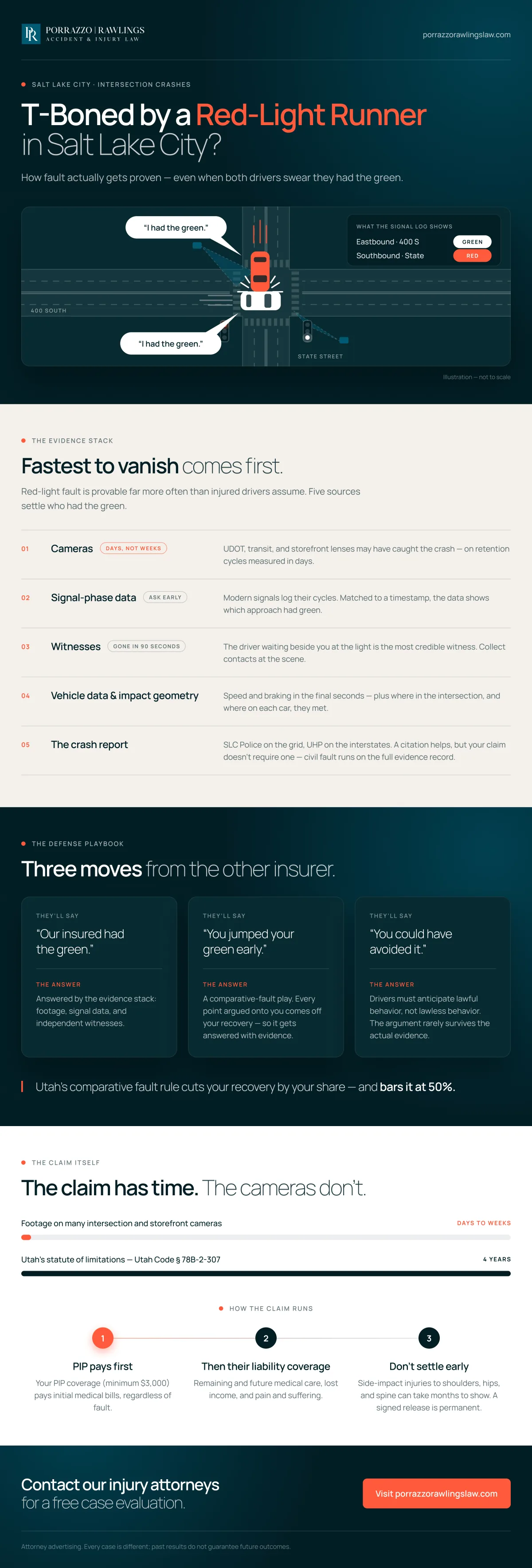
1. Cameras — fastest to vanish, strongest when captured. UDOT operates traffic cameras across the urban interstates and major arterials; the city’s downtown core adds transit-corridor equipment and wall-to-wall private storefront systems. Any lens with an angle on the intersection may have your crash — on retention cycles measured in days. This is the first thing to chase, and the reason the first week matters more than the fourth month.
2. Signal-phase data. Modern signals log their cycles. Paired with a timestamp — your 911 call, a camera clock — phase data can establish which approach had green at the moment of impact. It’s obtainable, but only by someone who knows to ask.
3. Witnesses. Pedestrian-heavy downtown intersections mean independent eyes. The driver waiting beside you at the light is the most credible witness a signal dispute can have — and gone in ninety seconds. Collect contacts at the scene, every time.
4. Vehicle data and physical evidence. Event data recorders in both vehicles capture speed and braking in the final seconds — a striking vehicle showing no brake application supports a driver who never saw a red they should have stopped for. Impact geometry adds more: where in the intersection the collision occurred, and where on each vehicle, reconstructs who entered legally.
5. The crash report. Salt Lake City Police for the grid, Utah Highway Patrol for the interstates; the officer’s diagram and any citation anchor the file. But a citation isn’t required for your civil claim to succeed — civil fault runs on preponderance of evidence, not on whether an officer witnessed the light.
The Defense Playbook — and Utah’s Rules
Expect three moves from the other insurer. “Our insured had the green” — answered by the evidence stack above. “You jumped your green early” — a comparative-fault play; Utah’s rule reduces your recovery by your fault percentage and bars it at 50%, so even manufactured percentage arguments cost real money if unanswered. And “you could have avoided it” — the last-clear-chance flavored argument that asks why you didn’t anticipate a violator; the law requires drivers to anticipate lawful behavior, not lawless behavior, and the argument rarely survives actual evidence.
Right-of-way disputes have cousins across the valley — we’ve covered the turn-yield version in our failure-to-yield T-bone guide — but the red-light version is distinct: it’s not a judgment-call about gaps, it’s a binary signal violation, which is exactly why the documentation matters so much.
Building that documentation while you’re injured is the practical case for representation: a car accident lawyer in Salt Lake City can have preservation requests out to UDOT, the city, and every camera-holding business within days, obtain the signal data, and put the insurer’s “green light” story against a record it can’t argue with.
The Claim Itself
Everything else runs on Utah’s standard machinery, which we’ve mapped step-by-step in our Salt Lake City crash guide: PIP pays your initial medical bills (minimum $3,000) regardless of fault; once bills cross the threshold or injuries qualify, the claim proceeds against the red-light runner’s liability coverage for full damages — remaining and future medical care, lost income, and pain and suffering. T-bone injuries in particular deserve patience before any settlement talk: side-impact trauma to the shoulder, hips, and spine often declares its full extent over months, not weeks, and a signed release is permanent. The general four-year statute of limitations, Utah Code § 78B-2-307, gives the claim time; the cameras don’t.
At Porrazzo Rawlings Accident & Injury Law, the promise behind that work is more than 100 years of combined experience and a deliberately limited caseload, so you work directly with a real attorney from the first call until your check is in hand. Bill Rawlings is a former insurance adjuster; the “both drivers claim green” file is one we’ve seen from the inside, and we know exactly which evidence ends the argument. For the statewide framework, see how car accident claims work across Utah.
Frequently Asked Questions
The police didn’t cite the other driver. Is my claim dead? No. Officers cite what they can support from the scene; your civil claim runs on the fuller evidence record — cameras, signal data, witnesses, vehicle downloads — under a lower standard of proof than a traffic citation requires.
The other driver’s insurer already denied fault. What now? A fault denial in a signal dispute is an opening position built on their insured’s story. It gets revised when footage, phase data, or independent witnesses contradict it — which is why evidence preservation, not argument, is the response.
Do Salt Lake City intersections have red-light cameras that automatically ticket? Utah law doesn’t operate automated red-light ticketing the way some states do — but that’s about citations, not evidence. Traffic-monitoring cameras, transit cameras, and private systems still capture crashes constantly, and that footage is obtainable for a civil claim.
What if I was partly blamed for entering the intersection? Utah’s comparative negligence rule preserves your recovery as long as you’re under 50% at fault, reduced by your percentage — and fault percentages assigned by an insurer are contestable, not final.
Hit by a Red-Light Runner? Move Before the Footage Does — Free
The driver who ran the light is already telling their version. The cameras saw the real one — for a few more days. Call (801) 553-0505 to speak directly with an attorney now — consultations are free, we’re available 24/7, and our attorneys serving Salt Lake City will get the preservation requests moving today. Zero-fee guarantee: you pay nothing unless we win or settle, and we advance all case costs.
Disclaimer: This article is for informational purposes only and does not constitute legal advice. Reading this article does not create an attorney-client relationship. Every case is different, and no guarantees or promises can be made regarding the outcome of any claim or the amount of any compensation. Past results do not guarantee future outcomes. If you have been injured, consult directly with a qualified Utah attorney about your specific situation.