
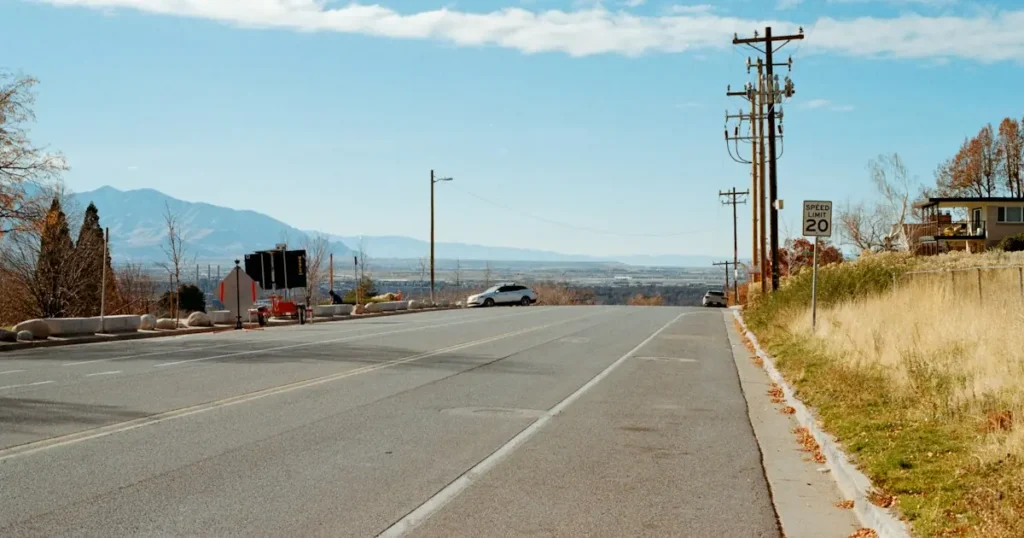
Nobody’s commute has changed faster than northwest Utah County’s. Eagle Mountain and Saratoga Springs have spent a decade among the fastest-growing cities in America — and nearly everyone who lives in them drives somewhere else for work. That’s why a car accident in Eagle Mountain or Saratoga Springs, Utah almost always happens on one of a handful of corridors carrying everyone at once: Pioneer Crossing (SR-145) funneling everyone toward I-15 at American Fork, Redwood Road (SR-68) running the Saratoga Springs lakeshore, and SR-73 climbing through Cedar Fort toward Eagle Mountain’s benches.
These are roads in transition — rural highways carrying suburban volumes, with new signals arriving yearly and long dark stretches in between. The crash patterns follow: high-speed T-bones at newly signalized crossings, head-on risk on two-lane segments, left-turn conflicts at every new subdivision entrance, and rear-endings where free-flowing traffic suddenly stacks behind a turn pocket.
If you were hurt in one of these crashes and it wasn’t your fault, here’s how the claim works — and what this corridor’s geography means for proving it.
Quick Answer: What should I do after a car accident in Eagle Mountain or Saratoga Springs, Utah? Move out of the roadway if you safely can, call 911, photograph the vehicles and scene, exchange insurance information, and request your crash report — the Utah County Sheriff’s Office serves Eagle Mountain, Saratoga Springs has its own police department, and the Utah Highway Patrol typically works the state routes. Utah’s PIP coverage pays your first medical bills regardless of fault, and drivers less than 50% at fault generally have four years to bring an injury claim — but on lightly cameraed rural corridors, physical evidence and witnesses matter even more than usual.
Why This Corridor’s Crashes Are Different
Speed differential is the killer variable. Pioneer Crossing, Redwood Road, and SR-73 all carry 50–60 mph traffic past intersections and driveways that didn’t exist five years ago. A driver misjudging one gap — pulling out of a subdivision onto Redwood Road, turning left across Pioneer Crossing — creates a T-bone at highway speed. These are among the most injurious crash types on Utah roads, and the fault analysis usually turns on right-of-way: the through driver’s speed versus the turning driver’s yield duty. Utah’s basic speed rule, Utah Code § 41-6a-601, requires every driver to run “reasonable and prudent” for conditions — but it doesn’t excuse a failure to yield, and statewide data from the Utah Highway Safety Office puts failure to yield among Utah’s top crash factors, at nearly one in five.
Fewer cameras, faster-fading evidence. Unlike the Salt Lake Valley’s camera-saturated arterials, long stretches of this corridor have no surveillance at all. That raises the value of everything else: your photos of skid marks and debris fields, vehicle damage geometry, event data recorder downloads, and witnesses — who, on a commuter corridor, are usually strangers headed somewhere and gone in a minute. Collect contacts at the scene, always.
Dark roads and long response times. Unlit segments of SR-73 and Redwood Road stretch response and clearance times. Photograph everything while you wait; the scene will be swept clean of its evidence by the time the tow trucks leave.
The youngest drivers in a young state. Eagle Mountain and Saratoga Springs have some of Utah’s youngest populations, which means a steady stream of new drivers on unforgiving roads. If the driver who hit you was a teenager, the coverage picture is broader than most people expect — household policies, license-application responsibility, and negligent-entrustment layers — and we’ve mapped it fully in our guide to who pays when a teen driver causes a crash.
The Claim, Step by Step
- Safety and 911. On two-lane segments, a stopped crash scene is a second collision waiting — get well off the roadway and stay visible.
- Over-document. With little camera coverage, your phone may hold the only visual record: all vehicles and plates, resting positions, skid marks, the intersection or driveway geometry, lighting conditions, and every witness contact.
- Know your report-holder. Eagle Mountain contracts law enforcement through the Utah County Sheriff’s Office; Saratoga Springs runs its own police department; the Utah Highway Patrol typically works SR-73, SR-68, and SR-145. The responding agency holds your crash report — figure 7–10 business days.
- Medical care, same day. Utah’s Personal Injury Protection (PIP) pays your first medical bills — minimum $3,000 — regardless of fault. High-energy T-bones are exactly the crashes where serious injuries hide behind adrenaline; document every symptom as it appears and tie it to the crash.
- Hold the line with adjusters. No recorded statements to the other driver’s insurer, no blanket medical releases, no early settlement while injuries are developing. In a disputed right-of-way case on a rural corridor, an Eagle Mountain car accident lawyer can commission the reconstruction work — vehicle downloads, damage analysis, sight-line studies — that substitutes for the cameras this corridor doesn’t have.
Utah’s standard rules complete the picture: comparative negligence preserves recovery below 50% fault (reduced by your share), and the general injury statute of limitations runs four years — with the usual caveat that the evidence on an unmonitored corridor won’t wait four weeks.
Growth Corridor, Grounded Representation
Families move to Eagle Mountain and Saratoga Springs for room to grow — and inherit the state’s longest, fastest commutes to get everything else. When one of those commutes ends in a crash, the promise we bring is the same one we bring everywhere: big firm settlements with small firm personal attention. Porrazzo Rawlings Accident & Injury Law has recovered hundreds of millions for injured Utahns while keeping a deliberately limited caseload — you work directly with a real attorney from the first call until your check is in hand, never a paralegal handoff, never a case number. Several of our attorneys are former insurance adjusters and defense lawyers; in disputed rural-corridor cases where the evidence is thin by design, that inside knowledge of how carriers evaluate — and undervalue — these claims is precisely the advantage. The statewide framework is in our overview of how car accident claims work across Utah.
Frequently Asked Questions
Who responds to a crash in Eagle Mountain — city police or the county? Eagle Mountain contracts with the Utah County Sheriff’s Office, so deputies typically respond and hold the crash report. Saratoga Springs has its own police department, and the Utah Highway Patrol usually works the numbered state routes.
The other driver pulled out of a subdivision onto Redwood Road. Isn’t fault obvious? Usually the yielding duty controls — but expect the insurer to argue you were speeding to shift a percentage of fault your way under comparative negligence. Vehicle data and damage analysis answer the speed question with numbers instead of guesses.
There were no cameras and no witnesses stopped. Is my claim sunk? No. Physical evidence — damage geometry, resting positions, skid marks, event data recorders — reconstructs most crashes without a single frame of video. It just has to be preserved before vehicles are repaired or scrapped.
How much does an Eagle Mountain car accident lawyer cost? Nothing up front. We work on contingency with a zero-fee guarantee — you pay nothing unless we win or settle your case — and we advance all case costs.
Hurt on the Commute? Get Answers Today — Free
Whether it happened at a Pioneer Crossing signal, a Redwood Road driveway, or a dark stretch of SR-73, get real answers before the insurers write the story for you. Call (801) 553-0505 to speak directly with an attorney — consultations are free, we’re available 24/7, and we come to you anywhere in northwest Utah County, from Eagle Mountain’s benches to our clients across Saratoga Springs.
Disclaimer: This article is for informational purposes only and does not constitute legal advice. Reading this article does not create an attorney-client relationship. Every case is different, and no guarantees or promises can be made regarding the outcome of any claim or the amount of any compensation. Past results do not guarantee future outcomes. If you have been injured, consult directly with a qualified Utah attorney about your specific situation.