

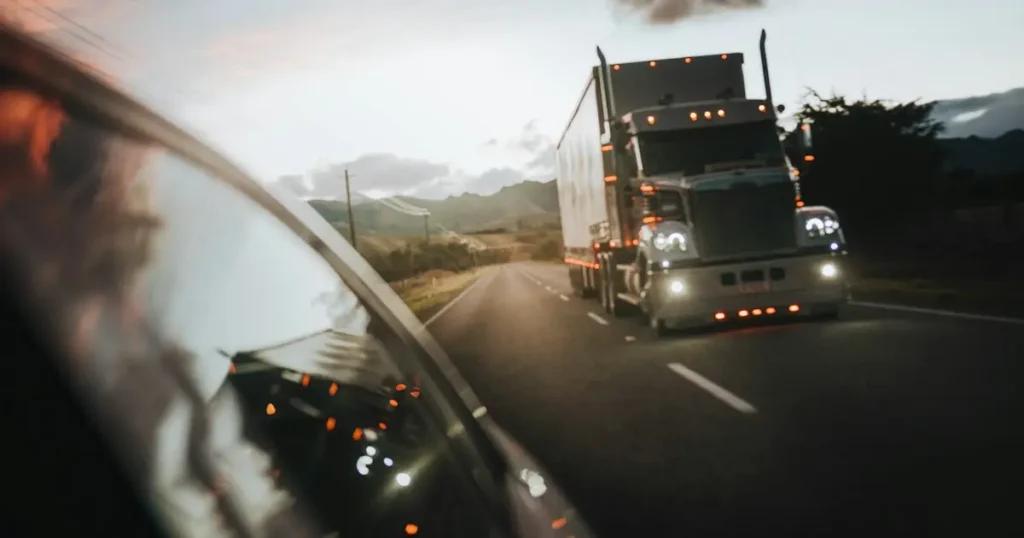
Every driver has felt it: the glance in the mirror at stopped freeway traffic, and the grille of a semi filling the glass. On Utah’s freight spines — I-15 through the Wasatch Front, I-80 across the Salt Flats and up Parley’s, I-84 splitting off at Ogden — traffic goes from 70 to zero without warning, and the vehicle behind you might weigh 80,000 pounds.
When a fully loaded semi rear-ends a passenger car, the physics are not negotiable. At highway speed, a loaded tractor-trailer needs roughly the length of two football fields to stop — dramatically more than the car it’s following — and every foot of following distance it didn’t keep becomes injury energy delivered to the vehicle ahead. That’s why being rear-ended by a semi truck in Utah produces some of the state’s most serious injuries, and some of its most aggressively defended claims.
Here’s what makes these cases different, and how injured drivers protect themselves.
Quick Answer: Who is liable when a semi truck rear-ends you in Utah? In most cases, the truck driver — and through them, the motor carrier — is liable, because commercial drivers are required to maintain following distance adequate to stop for the traffic in front of them under both Utah’s basic speed rule and federal safe-driving regulations. Liability often extends beyond the driver to the trucking company and other parties, and the decisive evidence — electronic logs, onboard data, dash-camera footage, and dispatch records — sits in the carrier’s possession and must be formally preserved before routine retention cycles erase it.
Why the Rear-Ending Truck Is Almost Always Liable
Rear-end fault logic is simple in Utah: following drivers owe a distance adequate to stop for what’s ahead of them. For commercial drivers, that baseline duty is reinforced by an entire federal rulebook. The Federal Motor Carrier Safety Administration regulates how long truckers can drive before mandatory rest (hours-of-service rules aimed squarely at fatigue), how vehicles must be maintained (brakes above all), and how carriers must supervise their drivers. A semi that plows into stopped traffic usually got there through one of a few provable failures:
- Fatigue. Hours-of-service violations show up in electronic logging device (ELD) records — when someone demands them in time.
- Speed and following distance for conditions. Utah’s basic speed rule applies to 80,000-pound vehicles with special force; “traffic stopped suddenly” is not a defense to inadequate following distance, on I-15 or anywhere else.
- Distraction. In-cab systems, phones, and paperwork — increasingly captured by forward- and driver-facing cameras many fleets now run.
- Brake and maintenance failures. Inspection and maintenance records are discoverable, and post-crash inspections regularly find violations.
Fault disputes in these cases rarely claim the truck didn’t hit you from behind. Instead, carriers argue percentages — you “cut in,” you “brake-checked,” your lights were out — hunting for comparative-fault deductions under Utah’s under-50% rule. The counter is data: the truck’s own onboard systems typically recorded speed, braking, and following behavior in the seconds before impact.
The Evidence Race You Didn’t Know You Entered
Here’s the structural difference between a car-versus-car rear-ending and a semi rear-ending: the best evidence belongs to the other side. ELD logs, engine control module data, dash-camera footage, dispatch and load records, driver qualification files, maintenance histories — all of it lives with the carrier, and all of it is subject to routine retention and overwrite cycles measured in days to months.
Carriers know this, which is why their insurers deploy rapid-response teams — sometimes reaching the scene the same day — and why injured drivers often get a friendly call “just to hear your side” before they’ve seen a doctor twice. We covered that call in detail in our guide to what to do when the trucking company calls after your crash; the short version is: decline the recorded statement, and get a preservation letter out the same week. A spoliation letter served early legally obligates the carrier to hold the evidence; a subpoena in month six often finds it “unavailable.”
If your crash happened in one of Utah’s known heavy-truck conflict zones — the Point of the Mountain’s wind-and-grade gauntlet is the canonical example, and our Draper I-15 corridor guide covers it — camera and traffic-data sources multiply, and so does the urgency of preserving them.
Why These Claims Are Valued Differently
Three factors separate semi rear-end claims from their car-crash cousins:
Injury severity. The energy differential produces disproportionate harm: spinal and disc injuries, traumatic brain injuries from violent acceleration, fractures, and internal injuries — often with long treatment arcs and future-care needs that must be projected, not just tallied. Settling before the medical picture is complete is the single costliest mistake in these cases.
Layered liability and bigger policies. Beyond the driver sits the motor carrier, sometimes a separate tractor or trailer owner, a maintenance contractor, or a freight broker — each a potential defendant, each with coverage. Federal law requires commercial carriers to carry far higher liability minimums than passenger vehicles, which matters precisely because serious injuries exhaust ordinary auto limits.
Defense sophistication. Carriers and their insurers defend these claims as a business function, with counsel involved from day one. Matching that requires the same on your side — which is exactly the work of a truck accident lawyer in Utah: preservation demands, data extraction, federal-regulation analysis, and valuation built on the full injury arc rather than the first stack of bills.
None of this means any particular outcome is promised — no honest attorney promises results. It means the claim’s ceiling is set by the quality of the evidence and the completeness of the damages picture, and both are decided early.
What to Do, Starting Now
- Get medical care immediately and follow through. Utah’s PIP coverage pays your first medical bills — minimum $3,000 — regardless of fault, and rear-end truck crashes are exactly where serious injuries hide behind adrenaline.
- Photograph everything at the scene if you’re able — the truck’s company markings, USDOT number, plate, trailer, and the full roadway context.
- Say nothing recorded to the carrier’s insurer. Cooperation with your own insurer is required; recorded statements to theirs are not.
- Preserve, formally and fast. The ELD, camera, and dispatch evidence that proves fatigue or following-distance failures will not wait for a lawsuit.
- Don’t negotiate against a business function alone. Free consultation, zero-fee guarantee, all case costs advanced — there’s no upfront-cost reason to face a carrier’s claims team by yourself.
Utah’s general four-year injury statute of limitations applies — and matters far less than the evidence clocks above.
Frequently Asked Questions
The truck driver got a citation. Is my claim automatic? A citation is strong fault evidence, not an automatic recovery. The carrier’s insurer will still contest injury causation, damages, and comparative-fault percentages — which is why the onboard data and complete medical documentation still matter.
The trucking company’s insurer offered a settlement two weeks in. Should I take it? Early offers in truck cases are priced before your injuries have fully declared themselves and before the carrier’s own evidence has been examined. Once you sign a release, the claim is closed permanently — including for treatment you don’t yet know you need.
What if the truck was owned by one company and driven for another? Common — and useful. Tractor owners, trailer owners, motor carriers, and brokers can each carry liability exposure and coverage. Sorting the corporate layers is standard work in these claims and often expands the available recovery.
How long is trucking-company evidence actually kept? Retention varies by record type — some electronic logs and camera footage cycle out within days to months under routine practices. That’s exactly why a formal preservation letter in the first week matters more than any later legal step.
Rear-Ended by a Truck? Start With Real Answers — Free
An 80,000-pound following error shouldn’t become your family’s financial emergency. Call (801) 553-0505 to speak directly with an attorney about your crash — consultations are free, we’re available 24/7, and our Utah truck accident team handles the preservation letters, the carrier’s insurer, and everything in between while you recover. Zero-fee guarantee: you pay nothing unless we win or settle your case, and we advance all case costs.
Disclaimer: This article is for informational purposes only and does not constitute legal advice. Reading this article does not create an attorney-client relationship. Every case is different, and no guarantees or promises can be made regarding the outcome of any claim or the amount of any compensation. Past results do not guarantee future outcomes. If you have been injured, consult directly with a qualified Utah attorney about your specific situation.