
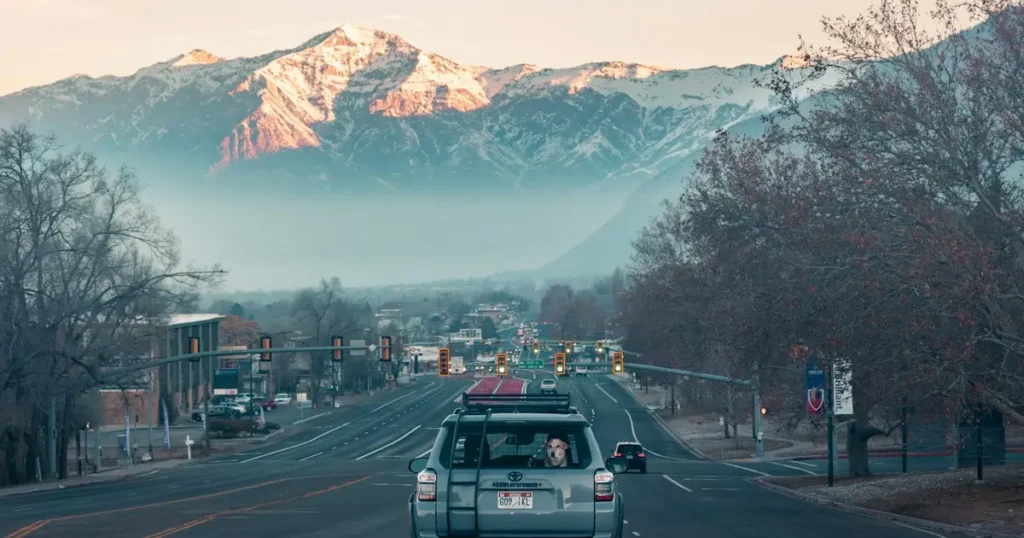
Provo traffic doesn’t behave like the rest of the Wasatch Front. Sixty thousand fans empty out of LaVell Edwards Stadium into neighborhoods built for a fraction of that volume. University Avenue runs the whole city north to south — commuters, students, and canyon traffic sharing one arterial with dozens of signalized intersections. Center Street crosses it through downtown. I-15’s Provo exits back up at rush hour, and every fall, Provo Canyon sends weather down 800 North that the valley floor didn’t see coming.
Tens of thousands of student drivers — many new to Utah roads, some new to any roads — cycle through the city every year. None of that makes crashes excusable; Utah law holds every driver to the same standard regardless of where they learned to drive. But it does shape how crashes happen here, and how claims get contested afterward.
If you were hurt in a car accident in Provo, Utah that wasn’t your fault, here’s the full playbook.
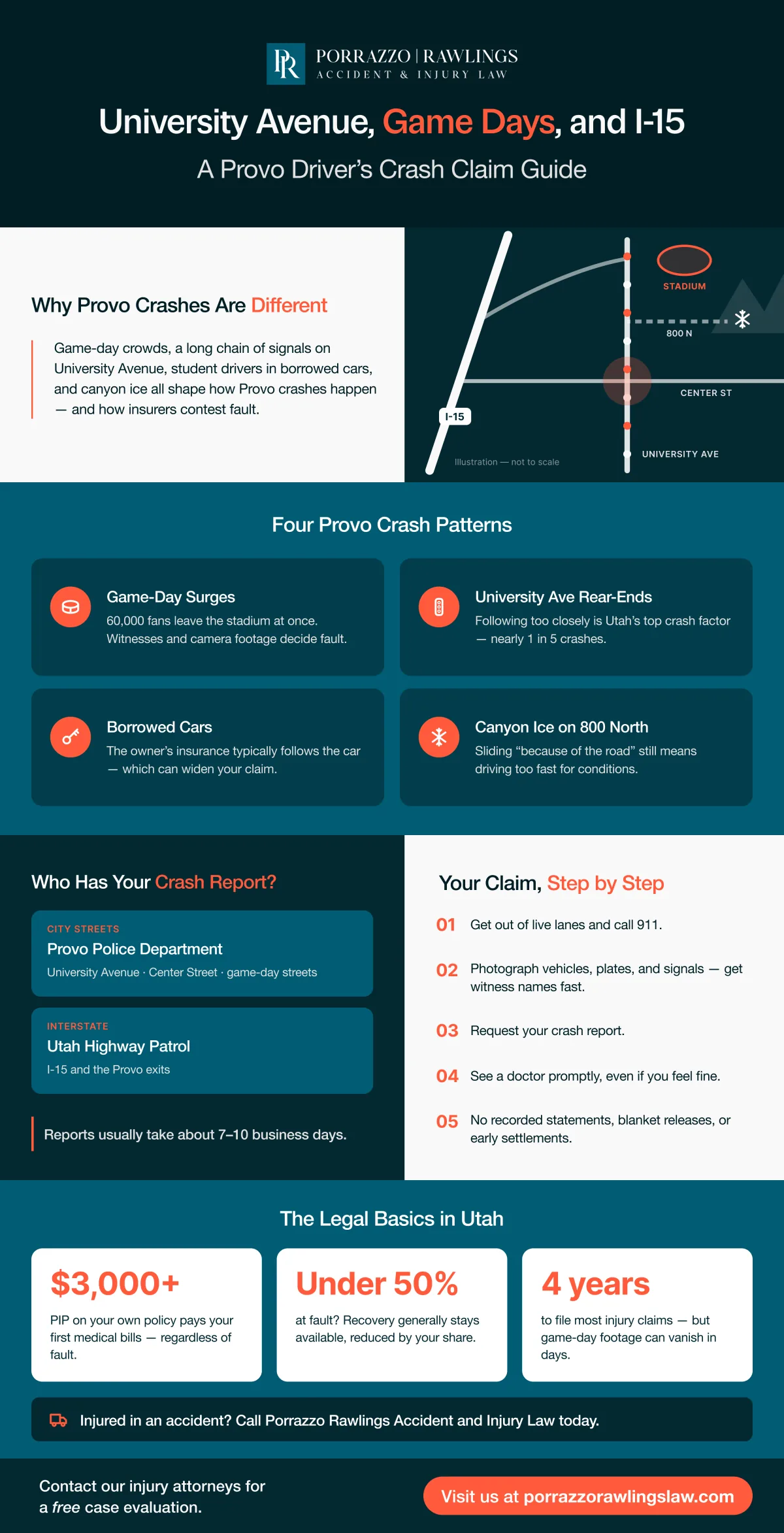
Quick Answer: What should I do after a car accident in Provo, Utah? After a Provo crash: get out of traffic, call 911, photograph the vehicles and scene, exchange insurance information, and request your crash report — Provo Police Department for city streets like University Avenue and Center Street, Utah Highway Patrol for I-15. Utah’s PIP coverage pays your first medical bills regardless of fault, and you generally have four years to bring an injury claim if you were less than 50% at fault — but game-day camera footage and witness contacts disappear far faster.
What Makes Provo Crashes Distinctive
Game-day surges. On football Saturdays, the streets around the stadium — 900 East, University Parkway, Canyon Road — compress a mid-size city’s worth of unfamiliar drivers into a few hours. Sudden stops, aggressive merges, and pedestrian-heavy intersections produce a predictable crash spike, and fault disputes to match: everyone’s insurer says the other driver was the impatient one. Independent witnesses and parking-lot or business camera footage decide these — if someone requests the footage before it’s overwritten.
University Avenue’s signal chain. A long arterial with closely spaced signals produces the classic rear-end pattern: a light changes, the lead car stops, and a following driver — often looking at a phone — doesn’t. Utah’s own crash data from the Utah Highway Safety Office puts following too closely at the top of the state’s contributing factors, at nearly one in five crashes. A rear-end crash on University Avenue is rarely a mystery; it’s a following-distance violation with paperwork.
Student drivers and borrowed cars. Provo crashes disproportionately involve drivers who don’t own the car they’re driving — roommates’ cars, parents’ cars registered out of state, borrowed trucks. That doesn’t weaken your claim; it usually widens it. The vehicle owner’s insurance typically follows the car, and Utah’s framework for owner responsibility means the policy covering the vehicle responds even when the driver was borrowing it. We’ve covered that structure in our guide to who is liable in a Utah car accident — the driver or the car owner.
Canyon weather on city streets. 800 North and the canyon mouth ice early. A driver who slides into you “because of the road” was, in Utah’s legal framing, driving too fast for conditions — the state’s basic speed rule requires adjusting to the surface, not just the speed-limit sign.
The Claim, Step by Step
- Safety and 911. Move out of live lanes; report honestly, including “I’m not sure yet” about injuries.
- Document. Photos of all vehicles, plates, signals, and the roadway; witness names before the crowd disperses — on game days, in minutes.
- The report. Provo Police Department documents city-street crashes; I-15 crashes usually belong to the Utah Highway Patrol, with statewide records through the Utah Department of Public Safety. Expect roughly 7–10 business days.
- Medical care, promptly. Utah’s Personal Injury Protection (PIP) pays your first medical bills — minimum $3,000 — regardless of fault. Delayed symptoms are routine; document everything that develops and connect it to the crash in every medical visit.
- Careful with adjusters. No recorded statements to the other side, no blanket medical releases, no early settlement while injuries are still declaring themselves. When fault is disputed or injuries are more than minor, a car accident attorney in Provo can preserve the fast-expiring evidence — game-day footage, signal data, vehicle downloads — and handle every insurer call while you heal.
The legal baseline is the same statewide: comparative negligence lets you recover as long as you were less than 50% at fault (reduced by your share), and Utah Code § 78B-2-307 generally gives injury claims four years — a deadline that matters far less in practice than the days-long lifespan of camera footage.
If the Other Vehicle Was a Truck
Provo’s I-15 corridor and University Parkway carry steady commercial traffic, and a crash with a semi or delivery truck changes the claim entirely — federal safety regulations, preservation deadlines for driver logs and onboard data, and a carrier-side response team that starts working the same day. Our Utah truck accident practice covers how those claims differ and why they’re valued differently.
One Valley, Two Cities, One Standard
Provo and Orem share a border, a commute, and a crash corridor — State Street flows into University Parkway, and thousands of drivers cross between the two cities daily. If your crash happened north of the line, our companion guide to drunk-driver crashes on Orem’s State Street covers Orem’s most serious pattern. Either side of the border, the claim framework — and our approach — is identical.
At Porrazzo Rawlings Accident & Injury Law, that approach is big firm settlements with small firm personal attention: hundreds of millions recovered for injured Utahns, with a deliberately limited caseload so you work directly with a real attorney from the first call until your check is in hand — never a paralegal handoff, never a case number. Several of our attorneys are former insurance adjusters and defense lawyers; when an insurer leans on “game-day chaos” to muddy fault, we know the counter, because we used to write the playbook. The statewide framework is laid out in our Utah car accident practice overview.
Frequently Asked Questions
Does it matter that the driver who hit me was a student driving someone else’s car? Not in a way that hurts you. The insurance on the vehicle typically responds regardless of who was driving with permission, and the owner’s responsibility framework can add layers. Identify both the driver and the registered owner at the scene.
Who writes the crash report for a game-day crash near the stadium? Crashes on Provo city streets are documented by the Provo Police Department. On heavy event days, response times stretch — photograph everything and collect witnesses while you wait, because that scene will clear fast.
The crash was on I-15 near the Provo exits. Is the process different? The investigating agency is usually the Utah Highway Patrol rather than Provo PD, so the report request goes through state channels. Everything else — PIP, fault rules, deadlines — works the same.
What does hiring an attorney cost? Nothing up front. We work on contingency with a zero-fee guarantee — you pay nothing unless we win or settle your case — and we advance all case costs.
Hurt in a Provo Crash? Get Real Answers — Free
Whether it happened on University Avenue at rush hour, in a game-day crush, or on the interstate, you don’t have to sort out the claim alone. Call (801) 553-0505 to speak directly with an attorney — consultations are free, we’re available 24/7, and our attorneys serving Provo will come to you, anywhere in Utah County.
Disclaimer: This article is for informational purposes only and does not constitute legal advice. Reading this article does not create an attorney-client relationship. Every case is different, and no guarantees or promises can be made regarding the outcome of any claim or the amount of any compensation. Past results do not guarantee future outcomes. If you have been injured, consult directly with a qualified Utah attorney about your specific situation.