
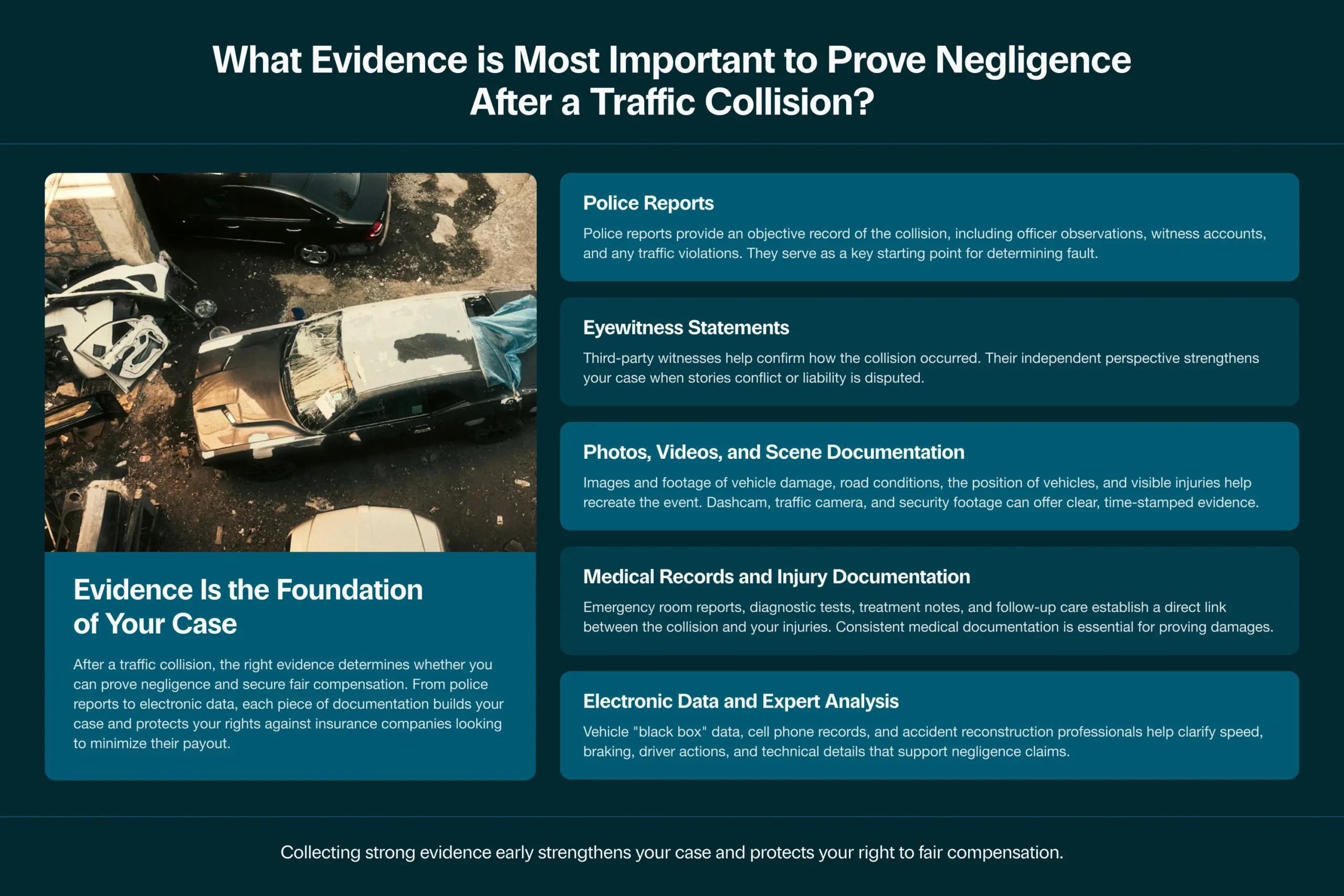
Proving negligence after a traffic collision is one of the most critical steps in a personal injury case. Whether you are seeking compensation for medical bills, lost wages, or pain and suffering, the success of your claim often depends on the strength of the evidence you gather. Courts and insurance companies rely on this evidence to determine who was responsible and whether their actions directly caused the injuries.
This article explores the most important types of evidence to establish negligence and why each piece plays a vital role in protecting your rights after a crash.
Police Reports: The Foundation of a Claim
One of the first pieces of evidence evaluated in traffic collision cases is the police report. After an accident, law enforcement officers investigate the scene, collect witness statements, and record observations about factors such as road conditions, weather, and potential violations of traffic laws.
While a police report itself may not prove negligence, it serves as a neutral and credible record that can support your version of events. Insurance companies often look to these reports as a starting point when deciding liability.
For example, if the report states that the other driver was cited for speeding or running a red light, this can directly strengthen your claim of negligence.
Eyewitness Testimony
Eyewitnesses can provide powerful support for your case. These individuals may include pedestrians, passengers, or nearby drivers who saw the collision unfold. Their statements offer an independent perspective on what happened and can either corroborate or dispute the drivers’ accounts.
Gathering witness information at the scene—names, phone numbers, and addresses—is crucial. Without it, finding those witnesses later can be difficult. Courts and juries often give considerable weight to unbiased third-party observations.
Photographic and Video Evidence
Photos and videos are among the most persuasive forms of evidence in traffic collision cases. Modern smartphones make it easy to capture:
- Vehicle damage from multiple angles
- Skid marks, debris, or fluid spills on the roadway
- The position of the vehicles immediately after impact
- Weather and lighting conditions
- Visible injuries
Video footage from traffic cameras, dashcams, or nearby security systems can also serve as strong evidence. Such footage often shows the sequence of events more clearly than witness testimony alone.
Medical Records
Medical documentation is critical to linking your injuries directly to the collision. Emergency room reports, physician notes, diagnostic tests, and rehabilitation records provide a timeline that connects the accident with the harm you suffered.
Without consistent medical evidence, insurance companies may argue that your injuries were pre-existing or unrelated to the crash. Keeping track of every appointment and treatment strengthens your ability to prove damages caused by the negligent party.
Expert Testimony
In more complex cases, expert testimony may be necessary to explain technical aspects of the collision. Accident reconstruction experts, for example, use physical evidence, skid marks, and vehicle data to recreate how the accident occurred. Medical experts may testify about the extent of injuries and the long-term effects on your quality of life.
These experts provide clarity in cases where the cause of the accident is disputed or when damages are contested.
Vehicle Damage and Repair Records
The damage sustained by your vehicle can reveal important details about the crash. Repair estimates, mechanic inspections, and photographs of the damage can help accident reconstruction experts determine speed, angle of impact, and the likely sequence of events.
This evidence not only helps prove negligence but also supports claims for property damage compensation.
Cell Phone and Electronic Records
With the rise of distracted driving, phone records can be crucial in proving negligence. If there is suspicion that the other driver was texting, making calls, or using apps during the collision, an attorney may subpoena cell phone records to confirm usage at the time of the crash.
Similarly, many modern vehicles store “black box” data—information such as speed, braking, and acceleration prior to the collision. This data can be powerful evidence when negligence is in question.
Admissions and Statements
Sometimes, the negligent party may admit fault at the scene. While drivers are advised to avoid discussing fault, statements such as “I didn’t see you” or “I was going too fast” can be powerful admissions if properly documented.
If these admissions are included in a police report or heard by witnesses, they may carry significant weight in establishing liability.
Why Strong Evidence Matters
Traffic collisions often result in conflicting stories. Each driver may interpret events differently, and insurance companies may attempt to shift blame to reduce payouts. Without strong evidence, it becomes difficult to prove negligence and recover fair compensation.
The National Highway Traffic Safety Administration (NHTSA) highlights the impact of crashes, noting: “The economic and societal impact of motor vehicle crashes on U.S. roadways was $340 billion in 2019.” This staggering number underscores the importance of ensuring claims are supported by credible, well-documented evidence to avoid financial loss falling unfairly on victims.
Steps to Take After a Collision
To maximize your ability to prove negligence, consider these immediate actions after a collision:
- Call 911 to report the crash and request medical help.
- Take photos and videos of the scene, vehicles, and injuries.
- Collect contact information from witnesses and other drivers.
- Seek medical attention promptly and follow up with your physician.
- Request a copy of the police report once available.
- Consult an attorney experienced in traffic collision cases to help gather evidence and protect your rights.
An Attorney Can Help
Proving negligence after a traffic collision requires a thorough approach to collecting and preserving evidence. Police reports, witness testimony, photos, medical records, expert opinions, vehicle data, and even cell phone records can all play pivotal roles in building a strong case.
By acting quickly and securing the right evidence, you improve your chances of establishing fault and receiving fair compensation for your injuries and losses. When in doubt, working with an attorney can provide guidance in organizing and presenting the evidence most effectively.