


You walked away from the crash. You told the officer you were fine, traded insurance cards in a parking lot off 9000 South, drove home, and felt lucky. Then, two mornings later, you couldn’t turn your head. Or the headaches started. Or your lower back seized up carrying groceries. Delayed injury symptoms after a car accident are the rule, not the exception.
If that sounds familiar, you’re not imagining it — and you’re not too late. Delayed injury symptoms after a car accident are among the most common patterns in injury medicine, and among the most commonly used against crash victims by insurance companies. This guide explains why injuries hide, which symptoms Sandy drivers should take seriously, and how late-appearing injuries affect a Utah claim.
Quick Answer: Can I still file a claim for delayed injury symptoms that appeared days after my car accident? Yes. Utah’s injury statute of limitations is generally four years from the crash, and delayed-onset injuries like whiplash, concussions, and soft-tissue damage are medically well documented. What matters most is getting examined as soon as symptoms appear and telling the provider your symptoms began after the crash — that medical record is what connects a late-appearing injury to the collision.
Why You Felt Fine (When You Weren’t)
The explanation is biochemical, not psychological. A collision floods your body with adrenaline and endorphins — the same stress response that lets athletes finish games on broken bones. For hours or even days, that chemistry masks pain and inflammation. As it fades, the actual injuries introduce themselves.
Some injuries are also mechanically delayed. Soft-tissue damage swells over 24–72 hours. Microscopic muscle and ligament tears stiffen gradually. A small disc injury can take days of ordinary movement before it presses on a nerve. None of this means the injury wasn’t caused by the crash — it means the crash’s effects unfolded on the body’s timeline, not the insurance company’s.
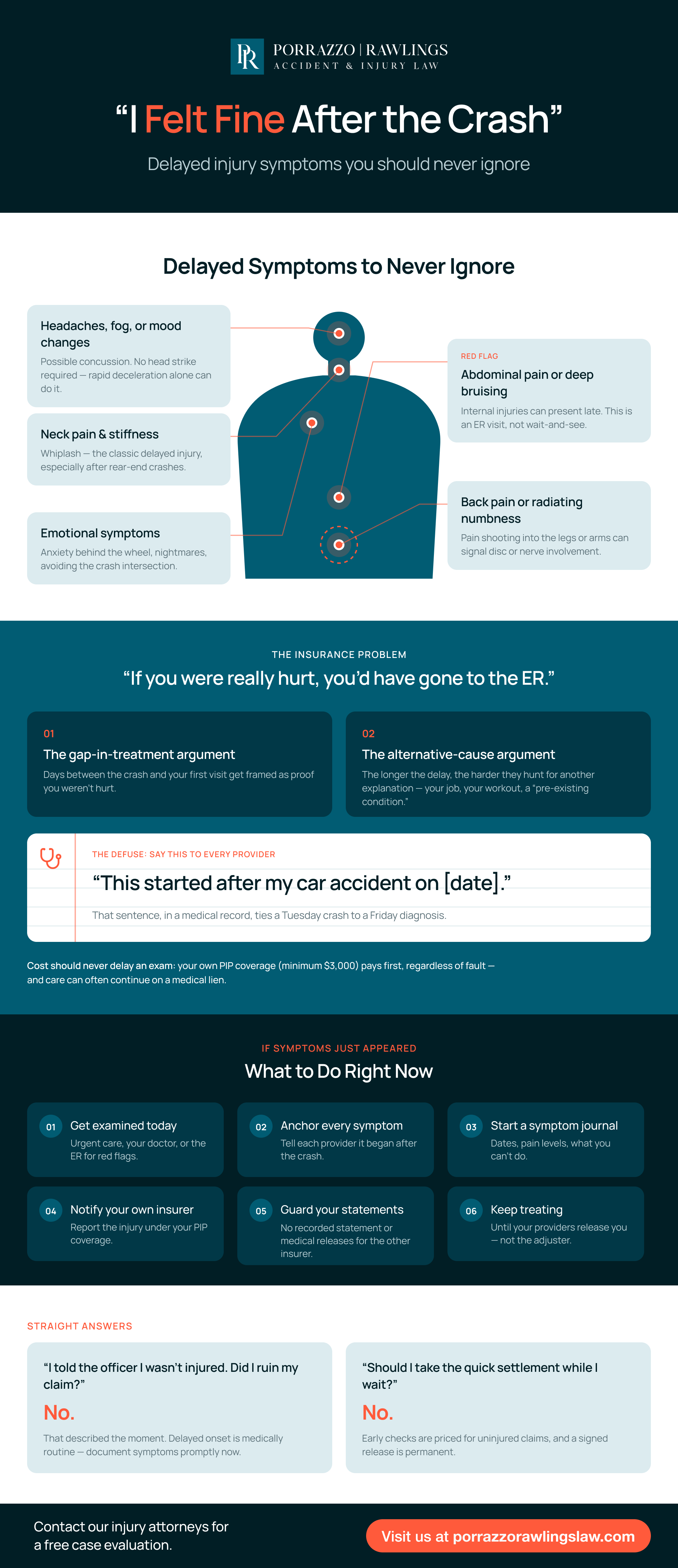
Delayed Symptoms Sandy Drivers Should Never Ignore
Neck pain and stiffness (whiplash). The classic delayed injury, especially after rear-end crashes on State Street or the I-15 ramps. Whiplash symptoms days after an accident — pain, reduced range of motion, headaches at the base of the skull — are the norm, not the exception.
Headaches, fog, or mood changes (possible concussion). A concussion after a car accident doesn’t require hitting your head; rapid deceleration alone can do it. Watch for persistent headaches, dizziness, trouble concentrating, sleep changes, irritability, or sensitivity to light. The CDC’s guidance on traumatic brain injury and concussion is clear that symptoms may not appear until days after the injury — and that anyone with worsening symptoms needs prompt medical evaluation.
Back pain or radiating numbness. Delayed pain after a rear-end crash that shoots into the buttocks, legs, or arms — or numbness and tingling — can signal disc or nerve involvement. Don’t “wait it out” past a few days.
Abdominal pain, deep bruising, or swelling. Rare but serious: internal injuries can present late. Abdominal pain, dizziness, or expanding bruising after a crash is an emergency-room visit, not a wait-and-see.
Emotional symptoms. Anxiety behind the wheel, nightmares, avoidance of the crash intersection — these are recognized crash injuries too, and they’re compensable in Utah when documented.
The Insurance Problem: “If You Were Really Hurt, You’d Have Gone to the ER”
Here’s where delayed injuries collide with claim reality. Adjusters lean on two arguments:
- The gap-in-treatment argument. Days between crash and first medical visit get framed as proof you weren’t hurt. This is why a gap in treatment hurts an insurance claim — not because the medicine supports it, but because the story is easy to sell.
- The alternative-cause argument. The longer the delay, the more the insurer hunts for another explanation: your job, your workout, your “pre-existing condition.”
You defuse both the same way: get examined as soon as symptoms appear, and say the words “this started after my car accident on [date]” to every provider. That sentence, in a medical record, is the thread that ties a Tuesday crash to a Friday diagnosis. Then follow the treatment plan — skipped appointments become exhibits in the insurer’s version of events.
One more Utah-specific point in your favor: your own PIP coverage pays your initial medical bills (minimum $3,000) regardless of fault, so cost should never be the reason you delay an exam. And if you don’t have health insurance for what comes after PIP, treatment can often continue on a medical lien — care now, paid from your settlement later.
How Delayed Injuries Affect What Your Claim Is Worth
Late-appearing injuries are fully claimable in Utah — medical bills, future care, lost wages, and pain and suffering — but they demand better documentation, because the insurer will contest causation harder. Timing also matters at settlement: if you’re still discovering symptoms, you are not ready to settle, no matter how quickly the adjuster pushes a check. Once you sign a release, a surgery you need six months later is your problem, not theirs.
This is the moment where having a Sandy personal injury lawyer evaluate your case changes the trajectory: connecting your medical record to the crash, coordinating lien-based care if you’re uninsured, and making sure no one settles your claim before your injuries have fully declared themselves. And if you’re still in the first days after your crash, our step-by-step Sandy crash guide covers the scene-and-report side of protecting your claim.
What to Do Right Now if Symptoms Just Appeared
- Get examined today — urgent care, your physician, or the ER for red-flag symptoms (worsening headache, confusion, abdominal pain, numbness).
- Anchor every symptom to the crash in what you tell providers.
- Start a symptom journal — dates, pain levels, activities you can’t do. Contemporaneous notes carry real weight.
- Notify your own insurer that you’re now claiming injury under your PIP coverage (report the injury; skip recorded blow-by-blow narratives).
- Don’t give the other insurer a recorded statement or sign medical releases before getting advice — with delayed injuries, both are traps.
- Keep treating until your providers release you, not until the adjuster gets impatient.
Utah gives you four years under the statute of limitations for most injury claims — but as our Utah personal injury practice page explains, the evidence and credibility clocks run much faster than the legal one.
You’re a Patient and a Person Here — Not a File Number
At Porrazzo Rawlings Accident & Injury Law, we’ve built the firm around one promise: big firm settlements with small firm personal attention. We’ve recovered hundreds of millions for injured Utahns, and we keep our caseload deliberately limited so every client works directly with a real attorney from the first call through resolution — never passed to a paralegal or case manager, never left wondering who’s handling your file. Delayed-injury cases in particular live or die on details: which record says what, which symptom appeared when. That’s exactly the kind of case where you want one attorney who knows yours completely.
Several of our attorneys are former insurance adjusters and defense counsel. We know precisely how the “gap in treatment” argument gets built — and how to take it apart.
Frequently Asked Questions
How long after a crash can symptoms appear and still be claimable? There’s no fixed medical cutoff — whiplash and concussion symptoms commonly surface within 24–72 hours, sometimes longer. Legally, Utah’s four-year statute governs the claim; practically, the sooner symptoms are documented, the stronger the causation case.
I told the officer I wasn’t injured. Did I ruin my claim? No. “I feel fine at the scene” is a statement about that moment, and delayed onset is medically routine. Prompt documentation once symptoms appear is what matters now.
Should I accept the insurer’s quick settlement while I wait to see if symptoms develop? No. Early checks are priced for uninjured claims. If symptoms are still evolving, the claim’s value is unknown — and a signed release is permanent.
Symptoms Showing Up Days Later? Get Answers Today — Free
If pain, headaches, or numbness have appeared since your Sandy crash, take both steps that protect you: see a doctor, and get your legal questions answered. Call (801) 553-0505 to speak directly with an attorney about your injuries — consultations are free, we’re available 24/7, and with our zero-fee guarantee you pay nothing unless we win or settle your case. We’ll meet you at home, at the hospital, or anywhere in the Salt Lake Valley.
Disclaimer: This article is for informational purposes only and does not constitute legal or medical advice. Reading this article does not create an attorney-client relationship. Every case is different, and no guarantees or promises can be made regarding the outcome of any claim or the amount of any compensation. Past results do not guarantee future outcomes. If you have been injured, seek prompt medical care and consult directly with a qualified Utah attorney about your specific situation.