
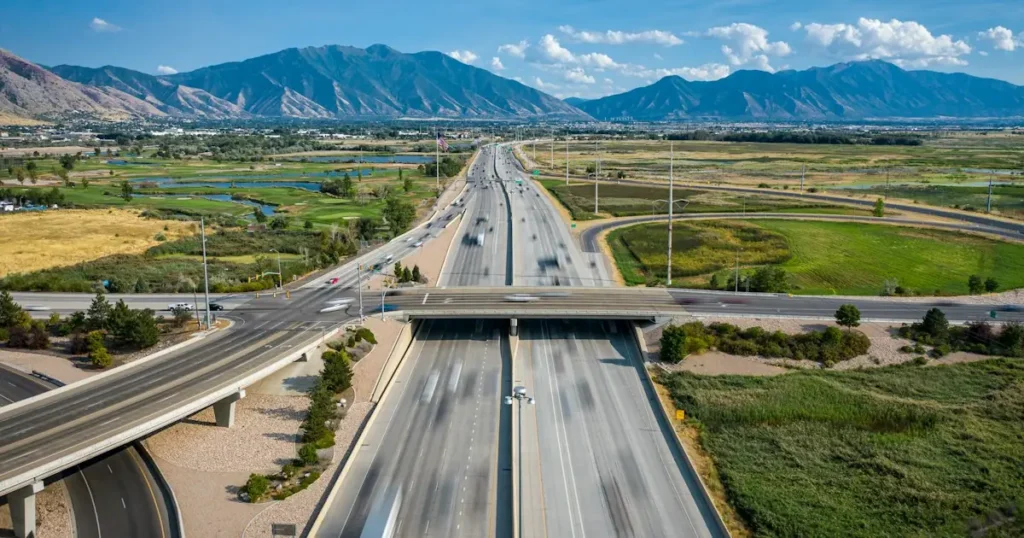
West Valley City is Utah’s second-largest city, its roads work harder than almost any in the state — and a car accident in West Valley City, Utah almost always traces back to one of a handful of overworked corridors. 3500 South runs the city’s whole width as its main street — retail, transit, and commuter traffic sharing seven lanes through a dozen major signals. SR-201 carries freight and commuters along the north edge toward the industrial corridor. Bangerter Highway cuts through at full speed, 5600 West stacks up at shift changes, and event nights at the Maverik Center pour thousands of cars onto arterials that were already full.
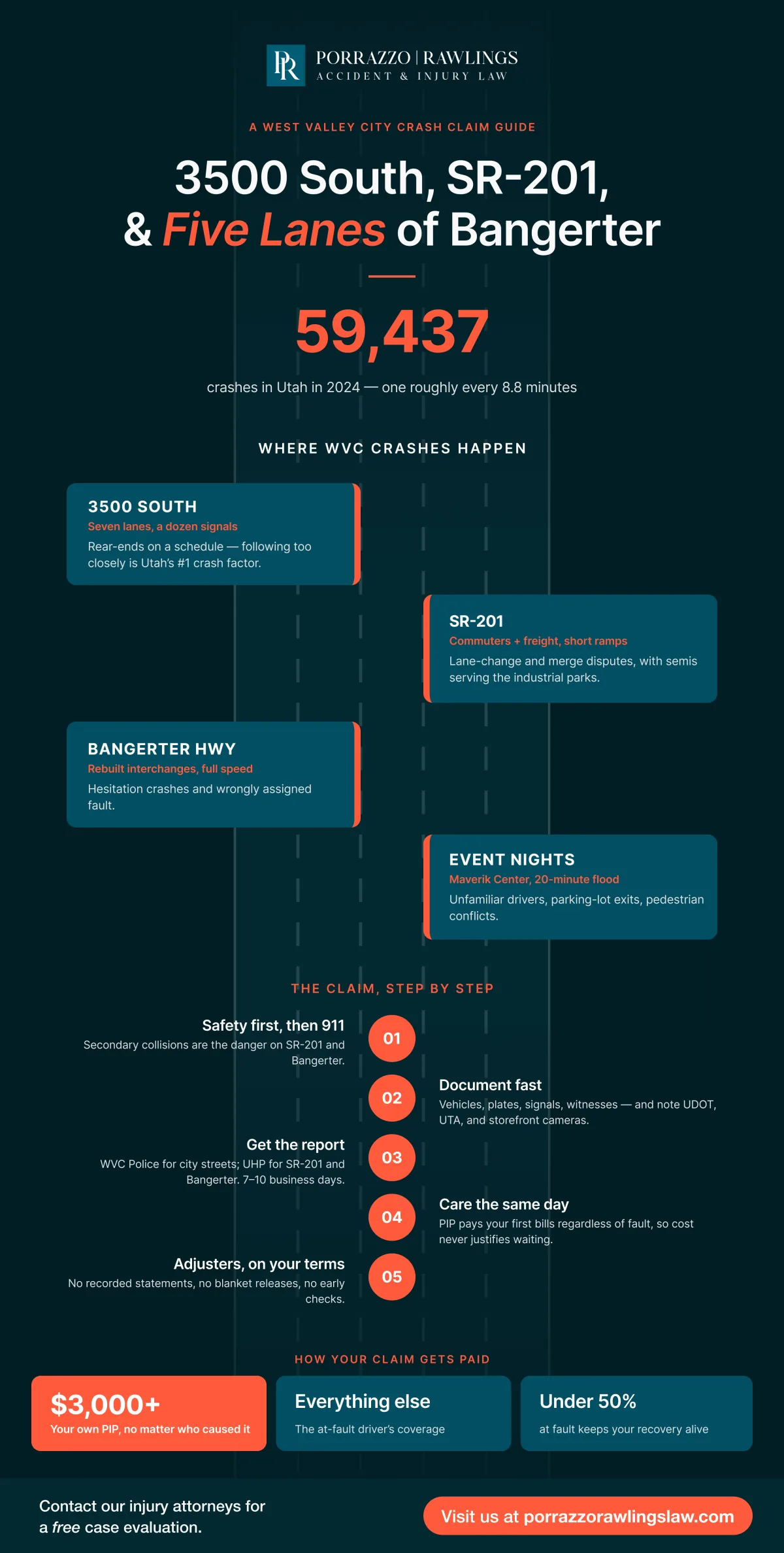
Crash risk follows exactly that pattern. Statewide, Utah logged 59,437 crashes in 2024 — one roughly every 8.8 minutes — with the heaviest concentrations on high-volume urban arterials like WVC’s. If you were hurt in a WVC crash that wasn’t your fault, here’s the complete guide to protecting your health and your claim.
Quick Answer: What should I do after a car accident in West Valley City, Utah? After a WVC crash: get out of the travel lanes, call 911, photograph the vehicles and scene, exchange insurance information, and request your crash report from the West Valley City Police Department (Utah Highway Patrol typically works SR-201 and Bangerter). Utah’s PIP coverage pays your first medical bills regardless of fault, and drivers less than 50% at fault generally have four years to bring an injury claim — though arterial camera footage in a city this busy is measured in days, not years.
Where WVC Crashes Happen — and Why Fault Gets Contested
3500 South’s signal chain. Long arterial, closely spaced lights, heavy transit and retail traffic: the corridor produces rear-end collisions on a schedule. Statewide data from the Utah Highway Safety Office puts following too closely at the top of Utah’s contributing factors — nearly one in five crashes — and a rear-ending on 3500 South is that statistic with your name on it. Expect the other insurer to try “you stopped suddenly”; expect the physics and any bus or business camera to say otherwise.
SR-201’s mix. Commuters and freight share a corridor with short ramps and older interchanges. Lane-change disputes and merge collisions dominate — and when the other vehicle is a semi serving the industrial parks, the claim changes character entirely (more below).
Bangerter at speed. WVC’s Bangerter crossings have been rebuilt into interchanges, and drivers still recalibrating to the new configurations produce hesitation crashes and wrongly assigned fault, the same pattern documented across the corridor’s southern stretch.
Distraction in stop-and-go. Utah’s Zero Fatalities program tracks distraction among the state’s leading crash factors, and WVC’s stop-and-go arterials are where it shows: a glance at a phone at 30 mph on 3500 South covers half a football field blind.
Event-night surges. Maverik Center crowds put thousands of unfamiliar drivers on Decker Lake Drive and 2200 West in a twenty-minute window — parking-lot exits, pedestrian conflicts, and impatient merges included.
The Claim, Step by Step
- Safety first, then 911. On SR-201 and Bangerter, secondary collisions are the immediate danger — shoulder or exit if the vehicle moves. Report every symptom honestly, including “not sure yet.”
- Document a busy scene fast. All vehicles and plates, the roadway and signals, and witnesses before they merge back into traffic. Note cameras: UDOT covers the highways, UTA equipment runs 3500 South, and the retail corridor is dense with private systems — all with short retention windows.
- The report. The West Valley City Police Department documents most city-street crashes; the state highways usually belong to the Utah Highway Patrol, with records through the state system. Figure 7–10 business days; start the claim before the paper arrives.
- Medical care the same day. Utah’s Personal Injury Protection (PIP) pays your first medical bills — minimum $3,000 — regardless of fault, so cost never justifies waiting. Late-appearing symptoms are routine; tie each one to the crash in your medical visits.
- Adjusters, on your terms. No recorded statements to the other side, no blanket medical releases, no early checks while injuries are still developing. When fault is contested — a 3500 South “sudden stop” story, a Bangerter interchange dispute — a West Valley City car accident lawyer can lock down the footage and data that decide these claims, and take every insurer call off your plate.
The statewide baseline runs underneath: comparative negligence preserves your recovery as long as you’re under 50% at fault (reduced by your share), and Utah Code § 78B-2-307 generally allows four years — a legal deadline the evidence never waits for. And when winter arrives, WVC’s wide arterials ice like everywhere else in the valley; our guide to how snow and ice crashes are assigned fault in Utah explains why “it was the roads” doesn’t move fault an inch.
SR-201 Freight: When the Other Vehicle Is a Truck
The industrial corridor along SR-201 and the city’s west side keeps commercial traffic constant — semis, box trucks, and work vehicles serving warehouses and distribution centers. A crash with any of them brings federal safety regulations, corporate liability layers, and evidence in the company’s possession — driver logs, telematics, onboard data — that must be formally preserved before routine cycles erase it. Our Utah truck accident practice covers how those claims run and why they’re valued differently.
Utah’s Second-Largest City, First-Name Service
A city of 140,000 deserves better than case-number treatment. At Porrazzo Rawlings Accident & Injury Law, the promise is big firm settlements with small firm personal attention: hundreds of millions recovered for injured Utahns, with a deliberately limited caseload so you work directly with a real attorney from the first call until your check is in hand — never a paralegal relay. Several of our attorneys are former insurance adjusters and defense counsel; the fault-shaving arguments built for busy arterials are arguments we’ve run from the other side, which is exactly why they don’t work on us. For the statewide framework, see how car accident claims work across Utah.
Frequently Asked Questions
Who investigates a crash on SR-201 or Bangerter in West Valley City? Usually the Utah Highway Patrol for the state highways, and West Valley City PD for city streets like 3500 South and 5600 West. The responding officer’s information tells you where your crash report lives.
The other driver’s insurer says I stopped suddenly on 3500 South. Now what? Treat it as an opening position, not a finding. Following drivers owe a distance adequate to stop; bus, transit, and business cameras along the corridor frequently show exactly what happened — if requested before retention windows close.
I was hit during a Maverik Center event rush. Does the chaos affect fault? Congestion never excuses negligence. Event traffic changes the evidence — more witnesses, more cameras, slower police response — but the fault rules are identical, and documentation at the scene matters even more.
How much does a West Valley City car accident lawyer cost? Nothing up front. We work on contingency with a zero-fee guarantee — you pay nothing unless we win or settle your case — and we advance all case costs.
Hurt in a WVC Crash? Get Answers Today — Free
From 3500 South to the SR-201 freight lanes, don’t let a busy city’s crash become your unpaid bill. Call (801) 553-0505 to speak directly with an attorney — consultations are free, we’re available 24/7, and our attorneys serving West Valley City will come to you, anywhere on the west side.
Disclaimer: This article is for informational purposes only and does not constitute legal advice. Reading this article does not create an attorney-client relationship. Every case is different, and no guarantees or promises can be made regarding the outcome of any claim or the amount of any compensation. Past results do not guarantee future outcomes. If you have been injured, consult directly with a qualified Utah attorney about your specific situation.